







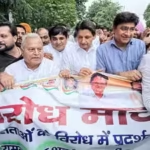
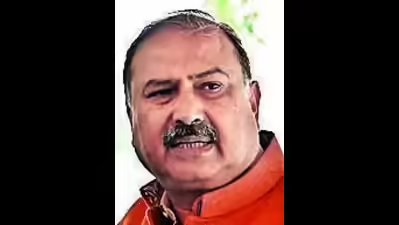
Jaipur: The demolition of the Noorani Masjid in Jaipur’s Nandpuri area by the Jaipur Development Authority (JDA) Monday has triggered a fresh controversy, with the Rajasthan Waqf Board alleging that the civic body violated legal procedures by razing a registered Waqf property without serving notice to the Board.Rajasthan Waqf Board chairman Khanu Khan Budhwali said the mosque was registered with the Board since 1986 and that the Board was the lawful custodian of the property. He alleged that JDA proceeded with the demolition despite a pending court case concerning the land, with the next hearing scheduled for June 10.“The JDA issued notices only to the local mosque committee and never informed the Waqf Board. This is a serious violation of due process and raises concerns over the protection of registered Waqf properties,” Budhwali said. According to him, the Board previously wrote to the authorities requesting that any action concerning the property be communicated to the Waqf Board before implementation. “No such notice was served to us,” he said, adding that legal options were being examined.The demolition has drawn sharp reactions from members of the Muslim community, who accused the authorities of acting in haste while the matter remained sub judice.Meanwhile, the issue has also taken a political turn after Congress MLAs Amin Kagzi and Rafeek Khan called the demolition an act of ‘targeting a community.’ Kagzi said that even if the road expansion was required, the mosque could have been reduced from 40 feet to 20 feet so that prayers could continue. Khan claimed that a shrine located at the site predates Independence and that Noorani Masjid was constructed in 1981 on land purchased through community contributions. He further alleged that development charges for the land were deposited with JDA in 1994 and questioned the authority’s decision to later designate the adjoining road as an 80-foot road under a master plan prepared after 2000.“Without any physical verification, the road was declared 80 feet wide. We met officials and sought a solution because there is no alternative place for offering namaz in the area, but no resolution emerged,” Khan said.