








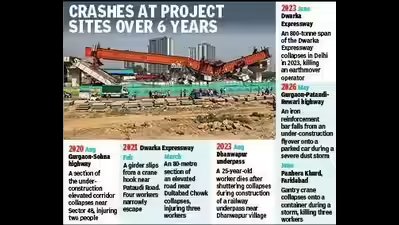
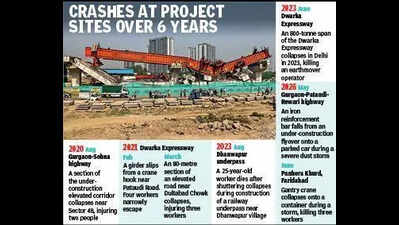
Gurgaon: The deaths of three workers after a crane collapse near Faridabad’s Panhera Khurd village on Thursday has once again put the spotlight on safety at NCR’s infrastructure projects.NHAI officials attributed the accident to strong winds. But the tragedy has revived a familiar question: if every major project is required to follow safety protocols, why do accidents continue to occur?In June 2023, an 800-tonne stretch of the Dwarka Expressway collapsed in Delhi, killing an earthmover operator. The same year, a worker died in a shuttering collapse at a railway underpass project in Dhanwapur. In 2021, a falling girder near Pataudi Road and an elevated road collapse near Dultabad Chowk injured several labourers. In 2020, a section of the under-construction Gurgaon-Sohna elevated corridor collapsed leaving two workers hurt.Just last month, a major tragedy was averted on Pataudi-Rewari Highway when an iron reinforcement bar fell from an under-construction flyover onto a car during a dust storm.Individually, each accident has been attributed to a different cause — mechanical failure, structural instability, procedural lapses, or adverse weather. Collectively, however, they point to a deeper issue.A former adviser to NHAI said there was no shortage of safety regulations governing infrastructure projects. Contractors are required to engage safety engineers, quality control personnel and certified equipment operators. Detailed procedures exist for lifting operations, traffic management, emergency response and worker protection.“The issue is whether these mechanisms are functioning effectively on the ground,” he said.Safety experts say the problem is the gap between compliance on paper and implementation at the site. Risk assessments may be prepared, audits conducted and safety manuals circulated, but their effectiveness depends on decisions taken during day-to-day operations.Saikat Basu, chief mentor at Consultivo Group, a safety, ESG and risk management consultancy, said, “Causes of accidents generally fall into three categories — system failure, equipment or process failure, and human error. However, equipment failure and human error can largely be controlled if the safety management system is robust.”Basu further said that weather and possible ground instability may have contributed to the Faridabad accident, but those were risks that should have been anticipated. “Heavy rain, strong winds or changes in ground conditions are well-known construction hazards. The key question is whether site-level job safety analysis and risk assessments were carried out before operations resumed,” he said.Basu said lifting activities were among the most hazardous. “Before any such operation begins, there should be a comprehensive hazard identification exercise. A lifting plan is not merely a compliance document; it must be reviewed and updated whenever site conditions change,” he said.The former NHAI adviser said shortage of qualified personnel was also a challenge. “Construction safety cannot depend solely on paperwork; it requires competent people on site who can identify risks and stop work when conditions become unsafe. Weather forecasting systems are available in real-time today, but the real issue is whether warnings are acted upon,” he said.Inquiries into accidents have often resulted in temporary suspensions, meagre financial penalties or short-term debarment of contractors and officials. In many cases, restrictions were lifted and projects resumed.Experts argue these have done little to prevent similar incidents from recurring.The former NHAI adviser said, “Responsibility often becomes diffused among contractors, consultants and authority engineers. Unless accountability is fixed clearly and transparently, lessons from such accidents are not fully learned.”Ultimately, Basu said, reducing fatalities required a shift in both mindset and enforcement.“Project deadlines and commercial pressures exist in every construction project. That is precisely why a strong safety culture is essential. No employee, supervisor or contractor should feel compelled to bypass safety requirements to meet timelines,” he said.“The two most important factors are management commitment and accountability. If project leaders genuinely prioritise safety, resources and attention will follow. And unless there are meaningful consequences, organisations are unlikely to treat safety failures with the urgency they deserve,” Basu added.