









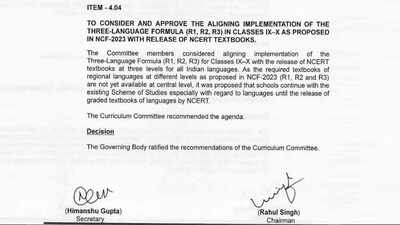
NEW DELHI: Senior Congress leader and Rajya Sabha MP Jairam Ramesh has launched a sharp attack on the Central Board of Secondary Education (CBSE) over its implementation of the three-language formula for Classes 9 and 10, alleging that the Board reversed its own earlier decision without any academic justification and under political pressure.In a detailed post on X, Ramesh questioned the circumstances that led to CBSE mandating the introduction of a third language from July 1, 2026, despite its Governing Body having reportedly approved the continuation of the existing language scheme just six months earlier. The Congress leader claimed the move has disrupted school planning and created uncertainty for lakhs of students across the country.Ramesh cites December 2025 CBSE Governing Body decisionAccording to Ramesh, the issue dates back to a meeting of the CBSE Governing Body held in December 2025. He said the Board’s Curriculum Committee had recommended that the existing scheme of studies, particularly concerning languages, should continue until the National Council of Educational Research and Training (NCERT) released graded language textbooks.Ramesh stated that the recommendation was “specifically and unequivocally” ratified by the Governing Body and was signed by the then CBSE Chairman and Secretary. However, in May 2026, CBSE issued a circular directing schools to implement a third language for Classes 9 and 10 from the upcoming academic session.He further alleged that schools were instructed to use NCERT’s Class 6 language textbooks to teach students in Class 9, despite the absence of dedicated textbooks for secondary classes.“What changed in the last six months?” Ramesh asked in his post, questioning why the Board departed from a decision that had already received formal approval.Congress leader alleges political interferenceThe Congress MP argued that there was “zero academic rationale” behind the policy shift and claimed that the move had thrown academic calendars and school planning into disarray.Ramesh alleged that the CBSE had effectively overruled its own Curriculum Committee and Governing Body despite no significant change in academic preparedness. He questioned whether the decision was taken on the instructions of the Education Ministry or other authorities.“The only agenda here is clearly political,” he wrote, alleging that autonomous educational bodies were functioning according to the political priorities of the government rather than recommendations from academic experts.The Congress leader also criticised what he described as a lack of accountability within the education system, claiming that administrative officials were being transferred while senior political leadership remained insulated from scrutiny.Three-language policy had already sparked nationwide backlashThe CBSE’s three-language mandate has been the subject of intense debate since its announcement earlier this year. Introduced under the framework of the National Education Policy (NEP) 2020, the policy made the study of three languages compulsory for Class 9 students, with at least two required to be Indian languages.The decision drew criticism from parents, students, educators and school bodies, many of whom argued that the policy was introduced midway through academic planning and placed additional pressure on students preparing for Board examinations. Concerns were also raised by families of students studying foreign languages such as French and German, who feared disruption to their existing academic pathways.Several education groups and parent associations demanded a review of the implementation timeline, while legal challenges were also filed questioning the feasibility of requiring students to take up a new language at the secondary level.