



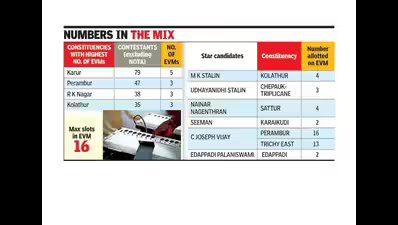
Chennai: Where a candidate’s name, symbol and photograph figure on the electronic voting machine (EVM) is decided by process laid down in the Representation of the People Act, 1951, the Conduct of Election Rules, 1961, and the Election Commission’s own manual.Candidates of recognised national and state parties form the first block. Next come candidates of registered but unrecognised parties. The last group is made up of independents.The returning officer arranges the names alphabetically within each group in Tamil and assigns numbers in that order. Initials and titles like “Dr” or “Prof” are ignored, as is the candidate’s stature. If there are eight candidates in the first block, the first registered-unrecognised party candidate will be number 9.That is how chief minister M K Stalin ends up at number 4 in Kolathur, and his son and deputy, Udhayanidhi, at number 3 in Chepauk. Stalin’s name will appear fourth on the first of the three ballot units used in his constituency, while Udhayanidhi will be third on the first of the two units wired together in his. In Kolathur, the names of three rivals — AIADMK’s P Santhana Krishnan, BSP’s Subashini and NTK’s Soundara Pandian Luder Seth — come ahead of Stalin in the Tamil alphabetical order. The “Sta” in Stalin does not correspond to a native Tamil consonant cluster, pushing him down the list. The same applied to TVK leader Joseph Vijay in Perambur — “Jo” is not a native consonant cluster. He is placed at 16, the last candidate in the second group of unrecognised parties, which means he is the final name on the first of the three EVMs in that constituency. His position in Trichy (East) is 13.Experts say a position on the EVM can work like a quiet campaign all its own. A name at the top enjoys prime visibility, catching the eye of rushed or undecided voters who may stop looking once they spot a familiar face or a symbol. The last slot can be sticky too, but less-known candidates in the middle of a long ballot — or on a second or third unit — may be buried in a blur of similar names, looks and symbols.Each ballot unit can hold only 16 candidates. The moment the list spills beyond that, a second unit is bolted on, and the sequence runs through. Returning officers say the system can, in theory, support up to 24 linked units, though Tamil Nadu will top out at five. Karur, with 80 candidates, highest in the state, will use five. Perambur, Dr Radhakrishnan Nagar and Kolathur will each need three, with NOTA pushed down to the final row of the last machine.