






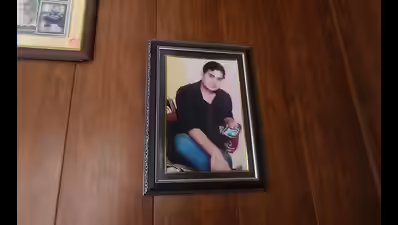
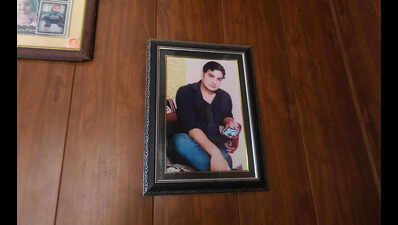
Faridabad: Allegations of foul play, corruption and an attempted cover-up — the death of a 32-year-old lineman, during a transformer repair, has touched off a row.A day after an FIR was registered against four people, Sonu’s family demanded a murder probe into what officials initially described as an accident in Faridabad’s Jajru village.Sonu’s wife Nirmal alleged on Thursday that her husband was exposing an electricity theft racket in which power was diverted from villages to private entities for profit, making him a target. “He was honest and refused to be part of corruption. That is why they killed him,” she claimed. Sonu’s family also alleged “severe workplace harassment”.“He told me he would leave this job but would never do any dirty work. He wanted to stay honest,” Nirmal, the wife of the victim — Sonu — said, alleging that her husband was under pressure from officials, particularly a junior engineer, to participate in “illegal electricity-related activities”.Nirmal questioned the circumstances, pointing out that while her husband was on the ground wearing protective gloves, he was electrocuted, whereas the co-worker on the pole survived, raising doubts about the sequence of events.Faridabad deputy commissioner Ayush Sinha said on Thursday that the matter is under investigation and assured that “necessary action will be taken based on the findings.” On Wednesday, the FIR was registered against multiple electricity department officials, including the foreman, junior engineer, SDO and executive engineer, under sections related to negligence, which the family argues are “inadequate”.On Thursday, the family alleged Sonu was often forced into exhausting shifts lasting up to 24 hours, leaving him with little time for family despite being the sole earner supporting his wife, two young children and parents. The family members demanded that charges under Section 302 (murder) be invoked.Sonu, an experienced electrical worker and former local sports player, left for his shift around 3.30pm on Tuesday but never returned home. According to his wife Nirmal, he was uneasy about the assignment, questioning why he and his colleagues were being sent to repair a transformer that had reportedly remained shut for over a year without any public complaint.As per the family, Sonu and a co-worker climbed the pole after securing an official shutdown permit, removing two jumper wires safely before attempting to cut the third. At that moment, power was suddenly restored to the line, causing a fatal electric surge that killed Sonu instantly. His father Rajendra said the family was informed around 7pm that Sonu was in ICU, but upon reaching the hospital, they found him already dead. “When I saw him, there was no life left. They lied to us. This is not an accident, this is murder,” he said, accusing officials of fabricating a story to escape liability.Remembered as a lively individual who loved cricket and kabaddi and cherished simple joys like food and family time, Sonu’s death has devastated the household, with his mother inconsolable and bedridden.State vice president of All Haryana Power Corporation Workers Union Jitender Tewatiya said the union facilitated a payment of Rs 10 lakh to the grieving family during the cremation, along with an additional Rs 25,000 for funeral rites.Tewatiya said the workers had already disconnected two phases of the transformer. While they were cutting the final phase, an unexpected current flowed through the line. “The regular employee, who was elevated on the structure, felt the shock and survived, but the outsourced worker on the ground grabbed the wire and was instantly electrocuted,” Tewatiya said.Tewatiya noted that the back current might have originated from an industrial generator in the area, though the exact source remains a subject of official investigation. Tewatiya revealed that within just the last month, eight to 10 power workers — both contractual and regular — died in “similar accidents across Haryana”.He attributed this alarming fatality rate to intense work pressure from officials, high summer temperatures leading to mental stress and hasty work, and a significant failure by management to properly distribute essential safety equipment.