







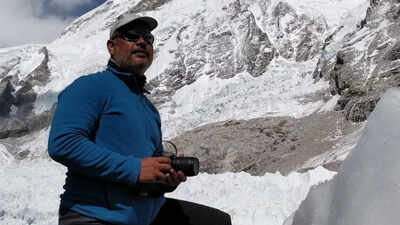
HYDERABAD: The family of Arun Kumar Tiwari, 53, a Hyderabad-based tech professional who died near the Hillary Step while descending Mount Everest last week, has decided to leave his body on the mountain, citing faith, his love for the Himalayas, and the near-impossible task of recovery from the “death zone”. Pioneer Adventure, which handled the Indian expedition team, initially quoted $114,000 (Rs 1.1 crore) for manual recovery of the body from an altitude of over 8,000 metres before reducing it to $94,000 (Rs 89.7 lakh) as a “solidarity concession”. It is twice the cost of summiting Everest. Nivesh Karki, owner of Pioneer Adventure, told TOI that his company charges $45,000 (Rs 42.9 lakh) for its 55-day all-inclusive Kathmandu–Everest–Kathmandu climbing package. However, he said body retrieval from the death zone becomes a separate and far riskier operation. He added that Tiwari suffered extreme exhaustion soon after starting the final ascent from Camp 4, but continued despite repeated advice from his personal Sherpa guide to descend. “He (Tiwari) said there was no way he was abandoning the dream when the peak was so clearly visible and within reach,” Karki said. Tiwari reached the summit but began vomiting blood while descending near the Hillary Step, deep inside Everest’s death zone above 8,000 metres, where the human body rapidly deteriorates due to extremely thin air. Sherpas tried to revive him with supplemental oxygen, but he died on the spot. The location made recovery of the body extraordinarily difficult. The Hillary Step is around 8,790 metres, barely 60 metres below the 8,848.86-metre summit. Helicopter evacuation is only possible from Camp II, around 6,400 metres, leaving Sherpas to move the body down nearly 2,400 vertical metres across the summit ridge and the mountain’s most exposed sections. “Retrieving the body now — five days after the tragedy — is almost impossible because the area is covered in deep snow. Sending Sherpas there would put more lives at risk,” Karki said. Karki said body retrieval missions from the death zone require 8–10 Sherpas to spend days cutting frozen bodies out of ice, securing them with ropes, and lowering them through exposed, avalanche-prone terrain to Camp II. The operation also consumes large quantities of bottled oxygen and exposes rescuers to frostbite, storms, exhaustion, and the risk of fatal falls. “Insurance covers helicopter evacuation, not manual recovery of a body,” he said. Tiwari was part of the Indian expedition team that also included Sandeep Are, 46, who died during descent after summiting Everest. Are’s body was recovered because he died lower on the mountain. “Are died around Camp III and his body could be brought down to Camp II because Sherpas who were descending managed to move him. From Camp II, chopper evacuation is possible,” Karki said. Tiwari, who is survived by his wife and two daughters, had attempted Everest in 2025 but turned back around 7,200 metres due to health issues before returning this season. His family said the decision to leave the body on Everest was not driven by money alone. Sudhir Upadhyay, Tiwari’s brother-in-law, told TOI that the family chose against retrieval after considering religious beliefs, the climber’s love for the Himalayas, and the physical toll the process would cause. “In our religious texts, Himalaya is the father of Goddess Parvati — Shiva’s consort. Devbhoomi. Anyone who dies there goes to Vaikunthdham. Bringing him back to earth is a sin,” he said. Upadhyay said the family viewed Tiwari’s death in the Himalayas as a form of “samadhi”, citing Hindu beliefs and the spiritual significance of the mountains. “He is now a part of the Himalayas — in a way, part of Shiva,” he said. “At that altitude, bones become brittle and the body would have suffered. His children should not see him mangled. There cannot be a more appropriate final resting place for him.” Karki said families whose relatives die on Everest can also face documentation complications because, without recovery and formal identification of the body in Kathmandu, the climber is often treated administratively as “missing” for a prolonged period. “If the body is not brought down, getting a death certificate becomes difficult because authorities need identification and post-mortem documentation,” he said. At least 344 climbers have died on Everest since recorded summit attempts began, and mountaineering estimates suggest around 200 bodies remain on the mountain because retrieval is too dangerous or prohibitively expensive. Meanwhile, Lt Col Barthwal, who led the expedition that included Are and Tiwari and coordinated rescue efforts on the mountain, suffered severe frostbite injuries to three fingers. He was airlifted by the Indian Air Force from Kathmandu and is currently recovering at Army Hospital in Delhi.