











India outlawed dowry in 1961. More than six decades later, thousands of women still die every year in marriages shaped by money, status and coercion.One bride pleads with her father over the phone: “Papa, they will kill me.” Hours later, she is found hanging inside her in-laws’ home.Another is allegedly buried hurriedly before even informing her parents. One family speaks of demands for a Fortuner SUV. Another says the taunts began within months of marriage. Another says their daughter was beaten, tortured and thrown from a terrace to make her death look accidental.Over just the past two weeks only, India has witnessed a succession of disturbing alleged dowry deaths and harassment cases — from Karnataka and Madhya Pradesh to Uttar Pradesh and Odisha — each horrifying in detail, yet painfully familiar in structure.In Karnataka’s Ballari district, 24-year-old Aishwarya allegedly died by suicide after what police described as mental harassment and dowry-related torture by her husband and in-laws. Cops said she left behind a note accusing them of abuse. Married for barely a year-and-a-half, she had reportedly returned to her parents’ home days before her death.In Greater Noida, 24-year-old Deepika died after allegedly falling from the terrace of her in-laws’ house. Her family insists she was beaten and thrown to make the death appear accidental. They alleged repeated dowry demands, including a Fortuner SUV, and pointed to multiple injury marks on her body.
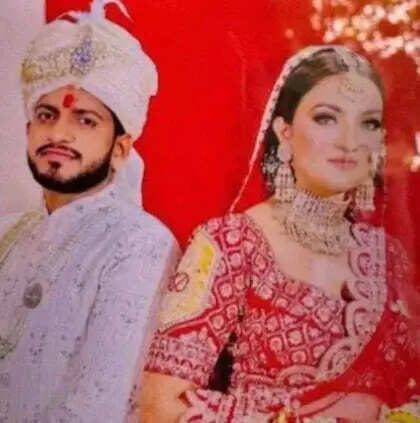
Deepika Nagar’s dowry case
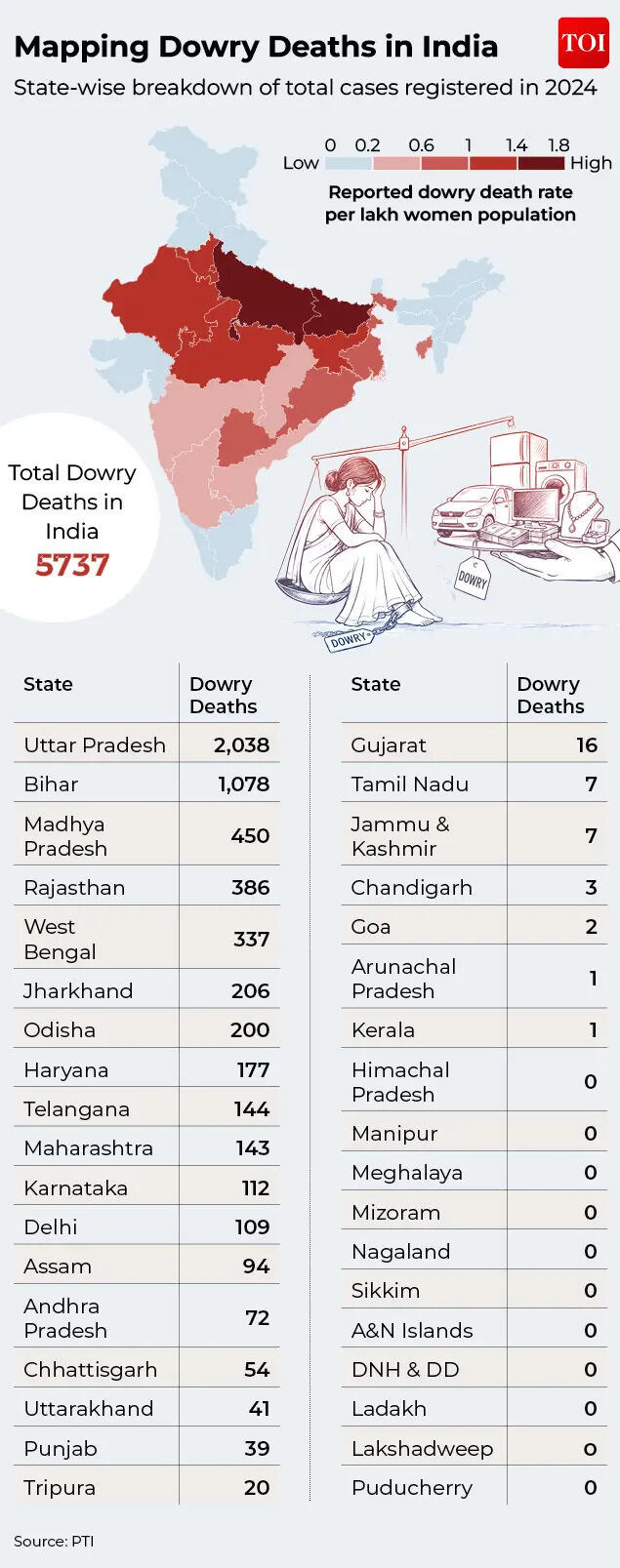
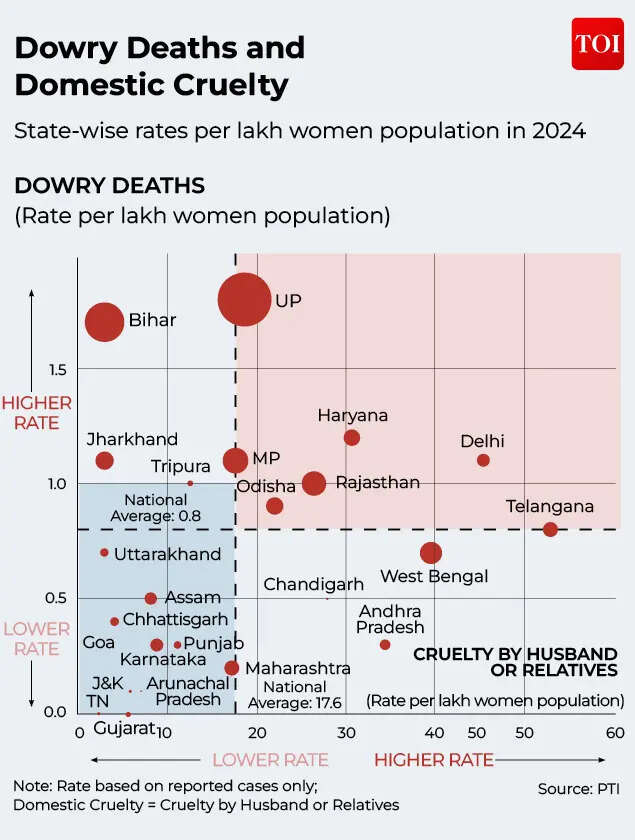
In Gwalior, 21-year-old Palak Rajak allegedly died after sustained harassment over demands for a vehicle. Her father said she repeatedly spoke about physical abuse and humiliation by her in-laws.In Odisha’s Jajpur district, police exhumed the body of 21-year-old newlywed Pramila Das after her father alleged she had been killed for dowry and secretly buried without informing her family.And in Uttar Pradesh’s Amroha district, 19-year-old Pushpendri Devi allegedly called her father crying just hours before her death. “Papa, they will kill me,” she reportedly said. Later that night, she was found hanging. Her family accused her husband and in-laws of demanding Rs 10 lakh and staging the scene as suicide.Different cities. Different social backgrounds. Different families.But the emotional architecture of these deaths remains almost identical.A crime that never disappearedAccording to National Crime Records Bureau (NCRB) data, India recorded 5,737 dowry deaths in 2024. The cases were registered under Section 80 of the Bharatiya Nyaya Sanhita (BNS) and the earlier Section 304B of the Indian Penal Code dealing with dowry death.The national dowry death rate stood at 0.8 cases per lakh women population.Uttar Pradesh recorded the highest number of dowry deaths at 2,038, followed by Bihar with 1,078 cases. Both states also reported the highest dowry death rates in the country — 1.8 and 1.7 per lakh women population, respectively.
Even metropolitan India remains deeply affected.Among major cities, Delhi has consistently reported some of the highest numbers of dowry death cases over the years, underlining that the problem is not confined to rural India or economically weaker households.The Supreme Court has repeatedly described dowry death as a “crime against society”, observing that such violence reflects deeply entrenched discrimination against women.But despite stricter laws, rising literacy, urbanisation and economic growth, dowry has not disappeared.It has modernised.The demands rarely stop after marriageWhat makes many of these recent cases especially haunting is how quickly the alleged harassment began.Some women had been married barely months.Police officials and activists say this is common. The wedding itself is often only the beginning of negotiations. Once the bride enters the marital home, new expectations emerge.A car. More jewellery. Money for a business. Help buying property. Expensive household items.When demands are not met, emotional abuse frequently escalates into intimidation, assault or coercion.Victims are often trapped between two fears: Violence at their marital home and social stigma if they return to their parents.Families, meanwhile, are conditioned to preserve marriages at all costs.Many women are told to “adjust”.Why dowry survives modern IndiaIndia’s economic growth and rising education levels were once expected to weaken dowry practices. Instead, in many places, dowry has adapted to modern aspirations.Researchers studying dowry practices have pointed out that higher incomes and consumerism often inflate expectations rather than reduce them. Marriage negotiations increasingly reflect class ambitions: cars, apartments, business investments and expensive lifestyles become symbols of status.In arranged marriages today, scrutiny around income, profession, social standing and lifestyle often overshadows emotional compatibility, Anand said, “While practical compatibility matters, a marriage ultimately cannot sustain itself without mutual respect, emotional security and equality between partners.”In India, dowry is rarely called dowry outright. Families describe it as “gifts”, “support”, “custom” or “help for the new couple”. Lawyer Chetan Anand said dowry in modern India has not disappeared — it has simply evolved. “Earlier it was overt cash demands; today it may manifest through expectations linked to lifestyle, status, expensive gifting, financial dependence or social positioning.”According to Anand, modern dowry conversations are increasingly disguised in the language of “compatibility”, “standard of living”, “family expectations” and “social parity”. “The terminology has changed, but the underlying pressures can still remain deeply transactional,” he added.Sociologists note that marriage remains deeply unequal for women despite educational gains. In many communities, daughters are still viewed as financial liabilities while sons are seen as economic assets whose marriage can elevate family status.This imbalance fuels a marketplace mentality around weddings.The result is a contradiction visible across India: highly educated professionals demanding dowry while publicly condemning it.
The economics behind dowryA study by economists Jeffrey Weaver of the University of Southern California and Gaurav Chiplunkar of the University of Virginia examined more than 74,000 marriages in India between 1930 and 1999 to understand how dowry evolved over time.Their conclusion was striking: Economic development did not weaken dowry. In many ways, it strengthened it.The study found that as education levels and job opportunities for men improved, dowry expectations also increased.“Over this period, more men were getting educated and getting better quality jobs, which led to rise in dowry,” Weaver noted.The researchers calculated “net dowry” — the difference between what the bride’s family gave and what the groom’s family gave — using data from India’s Rural Economic and Demographic Survey across 17 states.Their findings showed that nearly 90% of marriages studied until 1999 involved dowry payments. Between 1950 and 1999 alone, dowry transactions amounted to nearly a quarter of a trillion dollars.The logic behind the system was brutally transactional.In India’s marriage market, “higher quality grooms” — men with better education, govt jobs, stable incomes or higher social status — commanded higher dowries.As economic aspirations grew, marriages increasingly became negotiations around upward mobility.Cars replaced bicycles. Apartments replaced utensils. Cash payments expanded alongside consumerism.The study argued that dowry survived because families on both sides saw economic incentives in it.Bride’s families feared their daughters would otherwise end up with “lower quality” grooms. Groom’s families viewed dowry as compensation for investments made in sons’ education and careers.In other words, modernisation did not dismantle patriarchal marriage structures. It often inflated their price.Marriage still remains unequalThe persistence of dowry cannot be separated from the broader structure of marriage in India.Data from the India Human Development Survey and National Family Health Survey reveals how deeply traditional marriage patterns continue to shape society:
- More than 90% of marriages between 1960 and 2005 involved parental involvement in spouse selection.
- Nearly all marriages remain monogamous.
- Less than 1% end in divorce.
- More than 90% of women move into the husband’s household after marriage.
- More than 85% marry outside their village.
- Nearly 78% marry within the same district.
These patterns create intense dependence on marital families, especially for women with limited financial independence.The law exists. Convictions remain difficultIndia outlawed dowry through the Dowry Prohibition Act in 1961. Later, Section 304B of the IPC, now under Section 80 of Bharatiya Nyaya Sanhita, specifically addressed dowry death.Under the law, if a woman dies unnaturally within seven years of marriage and had faced dowry-related harassment soon before her death, the husband or in-laws can face prosecution.But legal experts say securing convictions remains difficult.Evidence often comes from inside the marital home, where witnesses may turn hostile. Families sometimes settle cases privately under social pressure. Delays in investigation and trial weaken prosecution.There is also another layer complicating the debate: Allegations of misuse of anti-dowry laws have led to political and legal pushback over the years.Women’s rights groups argue that while misuse exists in some cases, it is frequently exaggerated in public discourse, overshadowing the scale of genuine abuse and discouraging victims from coming forward.The larger reality remains undeniable — thousands of women continue to die in suspicious circumstances linked to dowry harassment every year.The burden of “adjustment”Perhaps the most enduring reason dowry violence survives is cultural conditioning.Anand said one of the biggest contradictions visible in recent cases is that financially educated and socially privileged families continue to face allegations linked to dowry harassment. “Education and outward modernity do not automatically guarantee emotional maturity, equality or respect within relationships.” From childhood, many women are taught that marriage requires sacrifice, endurance and compromise at any cost.Complaints against husbands or in-laws are often dismissed as immaturity. Returning home after marriage is treated as failure. Families fear social embarrassment more than danger signs.Even in cases of repeated violence, women are frequently advised to reconcile.Activists say this culture of forced “adjustment” creates an environment where abuse escalates unchecked.By the time police complaints are filed, the violence has often already become severe.Every case reveals a deeper failureWhat makes these recent deaths resonate nationally is not only their brutality, but their familiarity.Almost every Indian family recognises the ecosystem surrounding them.
- The “gifts” discussed before marriage.
- The subtle pressure to spend beyond one’s means.
- The fear of breaking an engagement.
- The whispered conversations after a daughter complains about harassment.
- The advice to compromise a little longer.
Dowry deaths are rarely sudden explosions of violence. More often, they are the final stage of sustained emotional and financial coercion normalised over time.And every time another young bride dies, India briefly mourns, debates the issue online and moves on — until the next case appears.But the repetition itself is the story.Because for all the claims of progress, modernity and empowerment, marriage in large parts of India still remains tied to a deeply unequal transaction where a woman’s worth is negotiated, priced and too often violently enforced.Despite strict anti-dowry laws, lawyer dAnand argues that legal reform alone cannot eliminate the problem. “The social mindset underlying dowry has not disappeared entirely — it has often become more sophisticated and less visible,” he says. “Until societal attitudes evolve alongside legal reform, such allegations and unfortunate incidents may continue to surface.”Beyond law, a social failureDowry deaths are not isolated crimes. They reflect broader inequalities around gender, inheritance, financial dependence and family honour.The persistence of dowry also exposes the gap between legal reform and social reality.India has produced generations of educated women, expanded workplace participation and strengthened constitutional protections. Yet inside many homes, patriarchal expectations remain intact.Marriage continues to determine a woman’s social legitimacy in ways it does not for men. Families continue to spend beyond their means to secure “good matches”. Sons continue to command social value in marriage negotiations.As long as these structures survive, dowry mutates rather than disappears.