










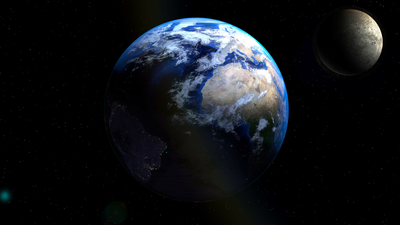
The Moon’s revolution around the earth is an example of gravity and motion in action which is quite intriguing. While it might appear that the moon just revolves around the earth, scientists state that it is actually falling towards earth all the time but is moving sideways at high speed so that it does not fall into the earth. NASA states this delicate balance of gravity, orbital velocity, and centripetal force ensures that the moon remains in its orbit at a distance of about 384,400 kilometers from earth. The reasons behind the moon’s non-collision with the earth’s surface give insight into space mechanics, satellite movement, space exploration, and planetary motion in the universe.
How gravity keeps Moon from falling towards Earth
It is held in place by the force of gravity that pulls it toward the Earth. The Moon is also moving sideways at about 3,680 kilometers per hour. It is this sideways motion that stops the Moon from falling into the Earth.Newton had explained this phenomenon in a very interesting way. He used the analogy of a cannonball shot from a mountain. If it moves at a low speed, it will hit the Earth. But if it moves fast enough, it will continuously fall around the Earth without ever touching the Earth’s surface. This is how the Moon works too.A graphic illustration from Cosmoknowledge carves a vivid image here:This movement of the Moon is called free fall. The Moon is continually falling because of the gravitational force of the Earth, but as the Earth curves away from underneath it at the same rate, it never touches the Earth. NASA says, “An object in space is in orbit when it travels fast enough to miss Earth as it falls”.
Orbital velocity and why the Moon never crashes
Orbital Velocity is the primary factor which keeps the Moon in orbit. In case the Moon traveled at slower speeds, it would simply fall on earth due to the effects of gravity. On the other hand, should the Moon travel at higher speeds, it would simply break out of earth’s gravitational pull. However, as fate would have it, the Moon travels at perfect speeds.It is this balance of speed which gives rise to Centripetal Force which is defined by physicists as the force required for an object to maintain its curved motion. Gravity from the earth supplies this force and continuously pulls the moon along a curved path known as Orbit.Albert Einstein furthered human understanding of gravity by formulating his theory of General Relativity. Einstein postulated that massive objects like Earth bend the space-time continuum and that the moon follows this curve to circle the earth.Despite the stability observed in the orbits of celestial objects like the moon, research conducted at the National Radio Astronomy Observatory has revealed that the moon is actually slowly receding from earth at a rate of 3.8 cm/year.
Why the Moon’s orbit matters for life on Earth
The orbit of the Moon serves not only to provide beautiful night illumination but also drives tidal forces, keeps the axial tilt of the planet stable and impacts Earth’s climate. Scientists believe that the Earth’s climate would be much more unpredictable without the Moon that stabilizes the planet’s rotation.Moreover, understanding the mechanics of the lunar orbit was critical to the development of space flight technologies. Satellites, GPS navigation systems and missions to other planets are based on the same rules of orbital movement that the Moon uses to remain in its place.It might be hard to accept the fact that the Moon falls, but it is a great illustration of orbital motion. The Moon is not floating still in the space above our planet; instead, it is engaged in a complex cosmic waltz governed by the force of gravity, velocity, and curved space. This concept is among those best illustrating the laws of the universe.