









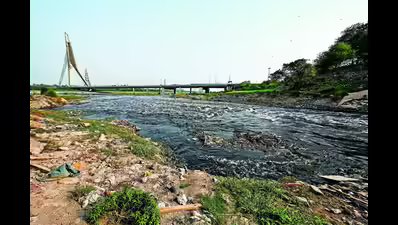
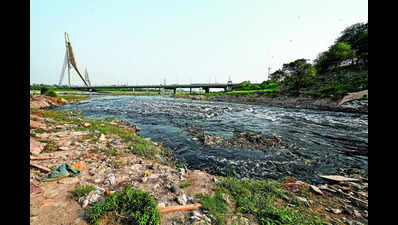
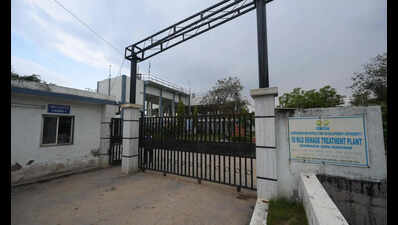
Gurgaon: Even as Gurgaon and Faridabad continue to expand rapidly, their sewage and drainage infrastructure has failed to keep pace. Large volumes of untreated wastewater are still flowing through overloaded drains linked to the Yamuna despite the presence of operational sewage treatment plants (STPs).Official records reviewed by TOI show Gurgaon has 12 operational STPs with a combined capacity of 415 MLD (million litres per day). However, only around 388 MLD sewage is reaching these plants, even though the city is estimated to generate nearly 433 MLD sewage daily. This gap indicates that a significant quantity of wastewater is bypassing the formal sewer network and flowing directly into drains.Officials estimate that around 287 MLD untreated sewage from Gurgaon continues to enter open drains connected to the Najafgarh drainage system, which eventually feeds the Yamuna in Delhi.STPs are facilities that treat sewage from homes, markets, apartments and industries before the water is discharged into drains or rivers. But in Gurgaon, major gaps in sewer connectivity, interception systems and drain management have prevented large sections of the city from being linked to treatment infrastructure.A senior Haryana State Pollution Control Board (HSPCB) official said many STPs were originally designed based on projected populations, but rapid and unplanned urban growth created sewage loads outside the planned network.“Illegal colonies came up later and were never part of the original sewage calculations. Now either those colonies have to be connected to sewer networks or interception pipelines have to be laid to divert that water to STPs,” the official said.The problem has worsened over the past decade as areas along Dwarka Expressway, New Gurgaon, Sohna Road and Manesar expanded faster than sewer and drainage infrastructure.Earlier surveys under the Yamuna Action Plan identified more than 287 MLD untreated sewage entering major drains from Gurgaon and adjoining areas. This included 55.4 MLD flowing through Badshahpur drain leg-I and another 78 MLD through leg-II. Pollution hotspots were also found at Udyog Vihar discharge points, Yakubpur outfall and several unidentified openings feeding the Najafgarh drain network.Officials identified at least 17 discharge points where sewage interception and treatment are still required.Hemant Kumar, chief engineer, GMDA, said authorities are trying to stop untreated discharge entering the three major drain systems linked to the Yamuna network.“In leg one, almost all untreated discharge has been stopped. In leg two, we are identifying points that need to be tapped because much of the drain is underground. In leg three, MCG has assured that all untreated discharge points will be tapped within three to four months,” Kumar said.He acknowledged that large quantities of sewage are still escaping treatment because of missing sewer links and untapped discharge points.“We are working to fix this within a year. New STPs are also being developed and are expected to be completed by 2027. We also plan an additional STP at Dhanwapur by 2030,” he added.According to HSPCB officials, the solution goes beyond building more STPs and requires extensive interception and tapping work across drains.“It is not just about building STPs. Separate tapping, interception and sewerage plans are underway. In some drains, dozens of discharge points have been identified where untreated water is entering,” an official said.Experts say this explains why rivers remain polluted even when treatment plants are technically operational.“If sewage itself does not reach the treatment plant, the river still gets polluted,” said Akanksha Tanwar, regional officer (north Gurgaon), HSPCB.To address the growing mismatch between sewage generation and treatment capacity, GMDA has proposed four new STPs — 100 MLD plants each at Dhanwapur, Behrampur and Sector 107, along with a 40 MLD facility at Naurangpur. Most are expected to be completed by 2027.A 25 MLD STP at Manesar and Naharpur Kasan is expected to become operational by Aug 2025, while a 2 MLD plant at Bajghera remains under construction.The review found that similar problems persist in Faridabad, another major urban centre in Haryana’s Yamuna catchment area.Two STPs in Faridabad, including the 45 MLD Badshahpur plant, were found failing to meet prescribed discharge standards.Vishal Bansal, chief engineer of Faridabad Metropolitan Development Authority (FMDA), said the Badshahpur STP had remained defunct for years before being rehabilitated recently.“Over the last six months, trial runs were unsuccessful due to issues with blowers and diffusers. But in the last 15 to 20 days, it has started functioning and HSPCB has also tested it,” Bansal said.The plant is currently treating 20-25 MLD sewage and is expected to gradually reach its full 45 MLD capacity over the next few months.Bansal said Faridabad until recently lacked adequate sewage treatment infrastructure altogether.“About a year ago, even the STPs were not there in Faridabad to treat wastewater. Most of the sewage was going untreated into drains,” he said.According to him, around 300 MLD treatment capacity has become functional in the past year and nearly 200 MLD sewage is now being treated.“It may take another six months to one year to connect all sewage lines to the STP network,” he added.Across Haryana’s Yamuna catchment, around 1,239 MLD sewage is generated daily. Although the state has installed 91 STPs with a combined capacity of 1,519.7 MLD, only around 1,100 MLD sewage is actually reaching these facilities, leaving a substantial volume untreated.The review also found 12 STPs across Haryana failing to meet prescribed pollution standards, including plants in Faridabad, Rohtak, Bahadurgarh, Jhajjar, Gohana, Ganaur, Hathin, Hassanpur and Hodal.Industrial discharge is adding further pressure to the Yamuna system. Across Haryana’s Yamuna basin, 3,238 industries generate around 209 MLD industrial effluent. Gurgaon alone accounts for 685 industries discharging 74.3 MLD — among the highest industrial loads in the state.The report also flagged illegal sewage dumping by tanker operators and untreated discharge entering stormwater drains.According to HSPCB officials, Yamuna pollution reviews are now being held every 15 days with deputy commissioners, divisional commissioners and senior state authorities monitoring progress on STPs, interception points and sewerage links.“The pollution in Yamuna is a manifestation of untreated discharge over years,” said activist Varun Gulati, adding that industries avoiding treatment costs and illegal dumping remain major enforcement challenges.As a temporary measure, authorities are using bio-remediation and phyto-remediation techniques in drains across Gurgaon and nearby districts to reduce pollution before wastewater enters river systems.Groundwater monitoring by HSPCB also revealed contamination concerns across the Yamuna basin. Of 89 groundwater monitoring locations tested, 24 were found unfit for drinking water standards.