







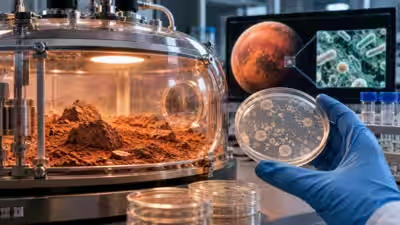
Scientists at the University of Florida have found that an Earth microorganism can grow for 160 days under a combination of conditions resembling a hypothetical environment beneath the surface of Mars. The team exposed the salt-loving microbe Haloferax volcanii to extremely low atmospheric pressure, a carbon dioxide-rich atmosphere without oxygen, and highly concentrated salt water. The cultures supplied with nitrate or perchlorate showed evidence of active growth and metabolism, despite growing more slowly than those kept under Earth-like pressure. The findings could help guide the search for potential microbial life on Mars, although they do not demonstrate that life exists there.
How scientists tested an Earth microorganism under Mars-like conditions
According to the study published in Applied and Environmental Biology, titled ‘Cultivation of halophilic archaea in shallow subsurface Martian conditions has implications for extant life on Mars’, the team selected Haloferax volcanii, an extremophile known for its ability to live in highly salty environments, to establish whether the microorganism could actively grow when several Mars-related environmental stresses were combined, rather than testing each condition separately.For the experiment, the researchers placed the cultures under an atmospheric pressure of 24 millibars, in an environment enriched with carbon dioxide and without oxygen. The microorganisms were grown in a highly concentrated salt solution containing 225 grams of sodium chloride per litre. The cultures were also supplied with either nitrate or perchlorate, which the microbe could use as alternative electron acceptors during anaerobic respiration. The experiment was maintained at 21 degrees Celsius for 160 days.
Earth microbe shows growth under simulated Martian conditions
The researchers recorded increases in optical density, a measurement used to assess changes in cell density, in cultures supplied with nitrate or perchlorate. They also observed reductions in the concentrations of these chemicals, providing additional evidence that the microorganisms were using them during metabolism. Cultures without either chemical showed no significant increase in optical density, helping distinguish active growth from the continued survival of the original cells.Although the microorganisms grew under the simulated Martian conditions, their growth was significantly lower than that of comparison cultures maintained at standard Earth atmospheric pressure. The researchers also found that growth supported by nitrate was greater than growth supported by perchlorate. According to the study, the combined increase in optical density and reduction of the supplied chemicals provided evidence of active microbial growth and metabolism under low-pressure conditions.
Earth microbes form dense clusters under simulated Martian conditions
The experiment also revealed changes in the physical structure of the microorganisms. Using scanning electron microscopy, the researchers observed dense cell clusters and biofilm-like structures in cultures grown under low-pressure conditions. The cells appeared embedded in an extracellular matrix, a feature that was not observed in the corresponding low-pressure control cultures that showed no detectable growth.The researchers also monitored how much liquid the cultures lost during the experiment. Despite the low atmospheric pressure, liquid loss remained below 4 per cent across all treatments after 160 days. The study recorded liquid loss of 2.13 per cent in cultures supplied with 100 millimolar nitrate and 2.02 per cent in those supplied with 100 millimolar perchlorate. The researchers suggested that the highly concentrated salt solution, together with the formation of biofilms, may have helped limit evaporation and maintain the liquid environment needed for microbial activity.
How the findings could guide the search for life on Mars
The study could help scientists refine how they search for potential microbial life beneath the Martian surface. The present-day surface of Mars is generally considered inhospitable to life because of its low atmospheric pressure, intense radiation, lack of stable liquid water and oxidising chemistry. However, researchers have proposed that some shallow subsurface environments could contain highly concentrated salty water, potentially providing more favourable conditions for microbial metabolism.The researchers stressed that the experiment did not establish that life exists on Mars. The laboratory conditions represented a hypothetical environment rather than one confirmed to exist on the planet. The cultures were maintained at 21 degrees Celsius, while much of the Martian shallow subsurface is considerably colder, and the microorganisms received nutrients supplied by the research team. “The results presented here do not imply that microbial life exists on Mars today.” Instead, the findings demonstrate that a combination of low pressure, high salinity and oxidising chemistry does not necessarily prevent microbial growth when liquid water and suitable chemical compounds are available. The work may also help scientists develop future life-detection experiments and assess the possibility of Earth microorganisms contaminating potentially habitable environments during Mars exploration.