







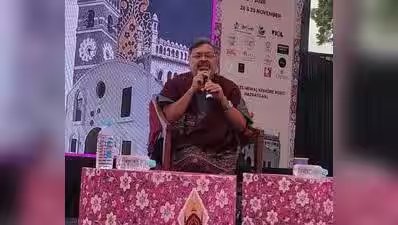
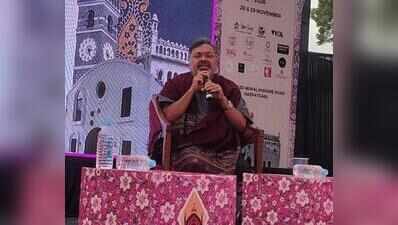
Lucknow: What if ‘Om Jai Jagdish Hare’, sung in millions of Hindu homes, carries the influence of Christian theology? Or that Indra, the mighty king of gods, originally rode a chariot rather than his familiar flying elephant? And that the humble bangle, not the Vedas, offers a glimpse into Hinduism’s earliest roots?Mythologist Devdutt Pattanaik challenged several deeply held beliefs at the Metaphor Lit Fest on Saturday, taking the audience on a fascinating journey through 5,000 years of faith, mythology and changing traditions.Speaking at a session titled ‘Itihasa: A History of Hindu Mythology’, Pattanaik traced Hinduism’s evolution as it absorbed cultural influences while reshaping its gods, rituals and traditions.“The idea of an all-powerful, distant God before whom we simply bow is not originally a Hindu concept; it is a very Christian idea,” he said, citing the 19th-century ‘aarti’ ‘Om Jai Jagdish Hare’.“Unlike the Hanuman Chalisa, which offers a complete description of Hanuman, detailing his appearance, powers and deeds, the ‘aarti’ avoids describing the God’s physical form, reflecting Western theological influence,” he argued.Questioning the belief that Hinduism originated with the Vedas, Pattanaik pointed to the Harappan civilisation.“The oldest symbol of Hinduism is the bangle, found 5,000 years ago in the Indus Valley, long before horses or chariots arrived,” he said.Indra’s transformation illustrated how powerful gods could lose their place in the religious hierarchy. The Vedic Indra rode a chariot, acquiring his familiar elephant later, when his supremacy had waned.“By the time of the Ramayan and Mahabharat, Indra gets an elephant, but his power is gone. You even find 2,000-year-old statues of Indra bowing to the Buddha,” he said.“Indra eventually yielded prominence to Shiva, Vishnu and Brahma. Similarly, traditions surrounding the fierce, buffalo-slaying Goddess emerged from the beliefs of farming, nomadic and tribal communities before being assimilated into Brahminical traditions,” he said.Pattanaik said Hinduism’s adaptability became evident during periods of temple destruction following the expansion of Islamic rule. Worship moved beyond temples, finding expression in household rituals, Haveli traditions, Nirguna Bhakti poetry and Ramlila performances.“You can destroy a temple, so we created something you cannot break,” he said. “How do you destroy poetry? How do you destroy a theatre actor?” he asked.Distinguishing ‘itihasa’ from modern history, Pattanaik said history relies on evidence and scientific inquiry, while ‘itihasa’ draws on faith and cultural memory.“One is a word of science, the other is a word of faith,” he said.