








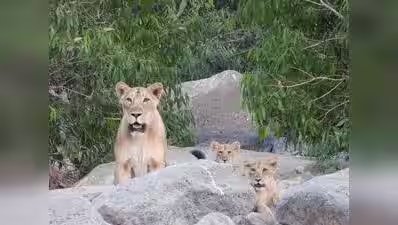
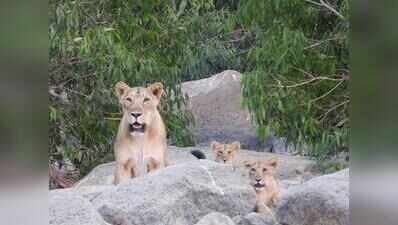
Rajkot: Less than four years after forest officials and wildlife activists celebrated the natural arrival of a sub-adult lion in Barda Wildlife Sanctuary in Jan 2023, the rapid growth of the big cat population has brought a new set of management challenges.With the lion count now reaching 26, officials anticipate that the 191-sq km sanctuary—spanning the Porbandar and Devbhumi Dwarka districts—is rapidly approaching its carrying capacity.According to estimates by Wildlife Institute of India (WII), Barda can accommodate between 30 and 40 lions. Once this saturation point is reached, the big cats are expected to spill over into non-protected revenue areas, including Bhanvad, Ranavav, Madhavpur, and Kalyanpur.The resurgence of lions in Barda, a region that served as their natural habitat roughly 145 years ago, is the result of more than a decade of preparation. In 2014, the forest department began the groundwork by establishing a breeding centre for sambar and spotted deer. Hundreds of captive-bred herbivores have since been released into the wild to build a sustainable prey base, complementing the sanctuary’s already sufficient population of wild boar. By 2015, the hilly terrain was deemed ready to host the predators.Following the extended stay of the first naturally dispersed sub-adult male in 2023, officials relocated five additional lionesses from Gir forest to Barda. Subsequent natural breeding pushed the population to 17 by Aug 2025, and to 26 this Aug.“These 26 lions are healthy and fit, and we continue monitoring them,” said Chirag Chandgude, deputy conservator of forests, Porbandar. “We believe a meta-population is already established, and we are exploring corridors for when the population increases further in the next few years.”In conservation biology, a meta-population refers to separated sub-populations of the same species linked through periodic dispersal. Officials note that the current situation mirrors the 1990s, when habitat saturation in Junagadh’s protected areas prompted lions to disperse into the revenue areas of Amreli, Bhavnagar, and Botad.A major concern for the department is that the majority of Barda’s current lion population consists of cubs. Once they mature into sub-adults, they will naturally begin seeking out new territories, accelerating dispersal across the wider landscapes of Porbandar and Devbhumi Dwarka.To prepare for a future where the local population could reach 70 to 80 lions, authorities are actively mapping out wildlife corridors to manage how the animals will coexist alongside human settlements. Wildlife observers expect that within the next few years, Porbandar, Devbhumi Dwarka, and Jamnagar will join Junagadh, Amreli, and Bhavnagar as high-density lion districts.