









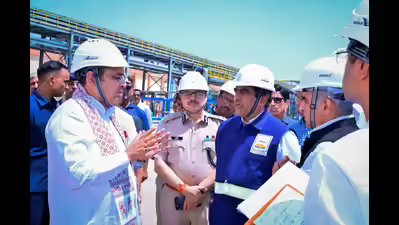
JAIPUR: Nearly 18 years after it was first conceived and after costs escalated from about Rs 43,000 crore to nearly Rs 80,000 crore, the Rajasthan refinery at Pachpadra is set for inauguration, coinciding with a period of global energy uncertainty triggered by tensions in West Asia. During the period, the ambitious project of the state faced delays, redesigns and political back-and-forth.The refinery’s origins trace back to 2004, when Cairn Energy discovered oil in the Mangala field of the Barmer basin, India’s largest onshore oil find in over two decades. The discovery ignited hopes of building a refinery within the state to process crude locally and boost economic development.Initial momentum, however, proved difficult to sustain. A proposal by Oil and Natural Gas Corporation (ONGC) in 2009 was shelved over viability concerns. The project was revived in Sept 2013, when Sonia Gandhi laid the foundation stone at Pachpadra.At that time, the refinery was estimated to cost Rs 37,230 crore and was structured as a joint venture between Hindustan Petroleum Corporation Ltd (74%) and the state govt (26%).A change in political leadership soon after led to a review and renegotiation of the project, pushing it into uncertainty. It was only in January 2018 that the project regained traction, when Prime Minister Narendra Modi inaugurated the start of work, with a revised cost of Rs 43,129 crore.Despite renewed momentum, the refinery continued to face delays due to land acquisition issues, environmental clearances and the Covid pandemic. These setbacks significantly escalated costs.On April 8, 2026, the Union Cabinet approved a final project cost of Rs 79,459 crore, nearly doubling earlier estimates. Commercial operations are now expected to begin by July 2026.Dubbed the “jewel of the desert,” the Pachpadra refinery is designed with a capacity of 9 million metric tonnes per annum (MMTPA), along with an additional 2 MMTPA of petrochemical output.It will process both imported crude and oil from the Mangala fields. Notably, the refinery features a high Nelson Complexity Index of 17, enabling it to handle a wide range of crude types, and will be India’s first to produce BS-VI-compliant fuel from inception.The project is expected to generate thousands of direct and indirect jobs, while reducing India’s petrochemical import bill by an estimated Rs 26,000 crore annually.