





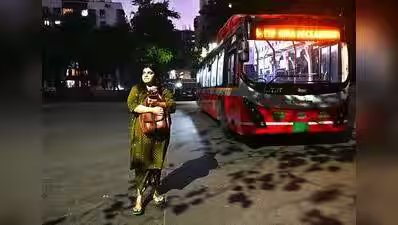
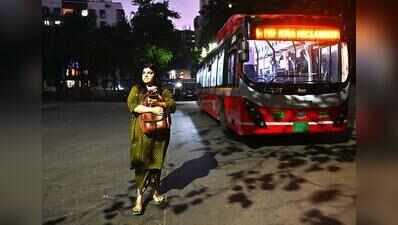
Mumbai: After her first couple of months on the new job, Ritu Sharma discovered the toughest part of the job—getting to and from work. “I tried various combinations of trains, buses and autorickshaws looking for the most affordable and least frustrating way to get from Mulund, where I live, to Bandra Reclamation, where I work,” says Sharma (31), a linguist with People’s Archive of Rural India.She began by staggering her office hours (10 am–6 pm), hunting for a sweet spot in the public transit system where ease, speed, and availability intersected: a seat on the train (Mulund to Dadar to Bandra) and a shorter bus ride (“that wouldn’t take 40 minutes from Bandra Station to Reclamation”).Failing to find one, and shunning autos over the cost, she changed her hours altogether. “I now work 2-10pm, walking to Bandra station and back”—a routine that a reliable public bus would have spared her, she says.Sharma’s story is the city’s story: commutes have grown longer and more strained, hobbling finances, health, and lifestyles as a crippled bus network forces people to wait, walk, or pay more in an already tight economic environment. With nationwide retail inflation at 6% and food inflation at nearly 9%, Mumbai auto drivers are pushing for a temporary Rs 2 fare hike to offset a 14% jump in CNG prices since January.In 2010-11 a sturdy machine with 504 routes and roughly 4,700 buses across Mumbai Metropolitan Region, BEST today is a sputtering service with 405 routes and 2,877 buses, 91% of them wet-leased. Declining ridership has long been BEST’s justification for slashing or shrinking routes, but commuters’ stories offer a different narrative.“Buses from Bandra (W) Station to Reclamation, such as the C-86, A-219 and 215, take 30-40 minutes to cover a 3-km distance,” says Sharma. “I’d rather walk 15 minutes through by-lanes than arrive frustrated to work.”For Shubham Padave (29), route 524L was a dependable east-west link that made his early-morning commute from Majas Depot in Jogeshwari East to APMC Market in Vashi effortless—a lifeline for first-shift workers. This Vashi–Borivali route was first truncated to Ghatkopar–Borivali and renamed A471 before vanishing altogether last month. Padave still remembers the day in 2021 when the conductor announced the curtailment. “The bus was packed,” he recalls, “but everyone suddenly went silent.”Today, his alternatives are longer and more tiresome. The A525 takes him via Airoli, while the A458 can get him to Mankhurd, but its first trip leaves Deonar for Borivali, making it unsuitable for early commuters heading towards APMC Market and Vashi. “Overall, my travel time has increased by up to an hour,” he says.Similar gaps have opened across the city. Routes 70, 80L, and 91L, which once served the busy Senapati Bapat Road corridor between Mahim and Lower Parel, have quietly vanished. Kurla residents point to route 309L, withdrawn in 2021 after years of directly linking Gorai and Kurla. Route 349 was curtailed to Marol Depot, and while route 319 covers part of the stretch, commuters say it is no substitute.These workarounds—private transport, multiple interchanges, long walks—carry a steep social and financial toll, robbing people of rest, leisure, and health while draining their wallets.Jagruti Bhanji (59), a fisherwoman from Versova Koliwada, says women now resort to cab-pooling (Rs 100 a seat) or hiring private tempos (Rs 50–60 a seat) to reach wholesale markets at Sassoon Dock, Colaba, or Crawford Market at dawn. “And we head to our respective markets with our fish by cab and tempo too, when previously we’d travel by (non-AC) buses. Now, the buses are so packed, we can’t even enter with empty baskets. The new buses don’t stop for us, anyway.” Private transport has pushed her travel costs up by 25%, she says.In 2019, Aamchi Mumbai Aamchi BEST (AMAB), a citizens’ transport forum, published a report from a March public hearing documenting how an increasingly privatised, shrinking bus fleet was hurting commuters. Parents reported children being punished for late arrivals caused by delayed buses—and some pulling kids out of school entirely. Students abandoned buses on exam days, daily-wage workers walked longer distances, and residents in underserved pockets struggled to reach public hospitals.Ridership has indeed dropped, from 42.06 lakh daily passengers in 2011 to 23 lakh in 2026, a decline BEST points to when pruning routes.“If the BEST has carried out any systematic study of bus ridership demand, it is a well-kept secret,” observes Hussain Indorewala, urban researcher and co-convener of AMAB, wryly. “In fact, there was no cost-benefit analysis carried out before taking the decision to wet-lease and no study has yet been carried out of its impacts,” he adds.The main causes of the decline, he says, are longer wait times and slower bus speeds, caused by traffic congestion that is itself a result of fewer public transport options, and increased bus fares. “Both can be fixed by the BMC by expanding the fleet, reducing fares, and providing dedicated bus lanes. Cancelling or curtailing bus routes is one of the causes of fall in bus ridership.”In the meanwhile, commuters are trapped between bad choices: women report groping on overcrowded buses, while packed, poorly ventilated AC buses heighten the risk of infections for everyone.BEST officials maintain that route cuts do not strand passengers, arguing that two to three alternatives usually run along the same corridor. They also promise to restore routes once the fleet expands to 10,000 electric buses over the next three to four years.Ritu Sharma isn’t waiting till then. She’s already considering a bike.