








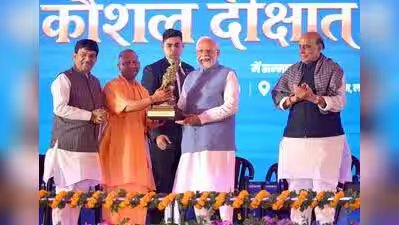
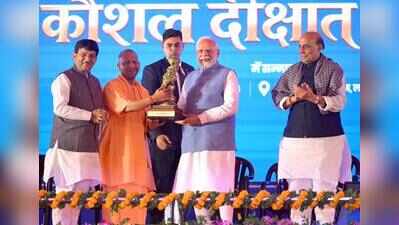
Lucknow: Seeking to dispel fears among youth that artificial intelligence could render millions jobless, Prime Minister Narendra Modi on Saturday asserted that the AI revolution would not threaten skilled workers, instead arguing that demand for trained manpower would only grow as India marches towards becoming a developed nation by 2047.Addressing the 5th Skill Development Convocation and a ceremony honouring 52 national toppers from Industrial Training Institutes (ITIs), National Skill Training Institutes (NSTIs) and private training institutions in Lucknow, the PM said that the coming decades would belong to those armed with practical skills rather than merely academic degrees.“Skilled workers will never be adversely affected by AI. The demand for skilled manpower is only going to increase in future. The importance of vocational and technical skills would become even more visible over the next 20 years as India works towards the goal of becoming a ‘Viksit Bharat’ by 2047,” he said.Modi’s approach to SI is defined by a pragmatic “middle path”— one that avoids heavy-handed rules that stifle innovation while rejecting unchecked technological determinism. As he framed it at the India AI Impact Summit 2026, India’s philosophy is to “give AI the open sky, but keep the command in our own hands,” much like a GPS that suggests a route while leaving the final direction to the driver.On Saturday, he underlined that India’s development ambitions would require a vast pool of technically trained youth capable of driving manufacturing, infrastructure expansion and emerging industries.“We are moving towards becoming the skill capital of the world,” he said.Citing his economic predictions that he claimed proved correct, Modi said he had earlier advised people against buying gold for a year amid global economic uncertainty. “People listened to my advice, and the price fell,” he said.Referring to the surge in public sector stocks, he recalled urging people in 2023 to invest in PSUs. “Those who followed that advice are ‘malamaal’ today,” he said.Highlighting the global demand for Indian labour and talent, Modi said leaders from West Asian countries frequently acknowledge the role played by Indian workers in building their advanced urban infrastructure.He said Covid-19 pandemic demonstrated how indispensable skilled workers were to society. “Skilled workers do not merely operate machines; they make people’s lives easier,” he said, crediting technicians, mechanics, electricians and other trained professionals for keeping essential systems functioning during the crisis.Showcasing his govt’s record on skill development, Modi said nearly 5,000 new ITIs had been established since 2014, increasing training capacity by around five lakh seats. He also highlighted the rising participation of women in vocational education, saying the number of female trainees had increased 2.5 times during the period.Terming skill development as core pillar of his govt’s growth strategy, Modi noted that a separate ministry of skill development and entrepreneurship was created after 2014 and vocational training was also given prominence under National Education Policy.Modi stressed the need to strengthen links between training institutions and industry so that skill programmes remain aligned with market requirements.He pointed to govt’s Rs 60,000-crore PM Internship Scheme as a major initiative aimed at enhancing employability and creating opportunities for young people. He said that the expansion of economic opportunities over the past decade helped nearly 50 crore Indians come out of poverty.Citing several examples of large-scale infrastructure projects, Modi said skilled workers were central to their execution.He said India managed to expand piped natural gas (PNG) connections despite disruptions caused by geopolitical tensions in West Asia, at one stage adding nearly one lakh connections every day.“The same skilled workforce was driving the growth of rooftop solar installations and helping expand domestic manufacturing, including in sports goods production,” he said.Recalling his tenure as Gujarat chief minister, Modi said he once asked officials to identify every service a person requires from birth to death. “The exercise uncovered nearly 1,000 services and reinforced the need to build a comprehensive skill-development ecosystem,” he said.Modi said the enthusiasm he witnessed among students at IIT-Kharagpur earlier in the day was equally visible among ITI trainees in Lucknow.“The real energy of Viksit Bharat lies in the skills of our youth. India’s transformation into a developed nation would be powered not just by technology, but by the hands and expertise of millions of skilled workers,” he said.In a veiled attack on past govts and colonial-era policies, Modi said India long remained trapped in a mindset that glorified white-collar jobs while undervaluing vocational skills.“The British rule systematically weakened India’s traditional industries and skill ecosystem by restricting education to the production of clerical manpower while promoting manufacturing in Britain. When invaders came, they first targeted India’s skilled industries and artisans because they understood that Bharat’s prosperity rested on its skills,” Modi said.He added that the country’s historical strength had been built on specialised crafts and vocational expertise.Expressing disappointment over societal attitudes towards vocational education, he said: “Many parents still feel disappointed when their children enroll in ITIs instead of conventional colleges, viewing factory jobs as less prestigious than professional careers.”“Our govt is determined to change this perception. We will ensure that students of ITIs receive the same respect as students of IITs,” he said.“Students from IITs as well as ITIs are equally valuable to me. Yahi mere desh ka samarthya hai, yahi mere desh ka bhavishya hai,” he said.