









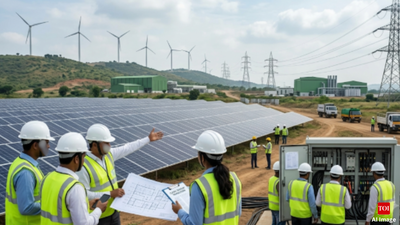
MUMBAI: Mobilising billions in domestic and overseas investments for India’s clean energy transition, modernising power grids and making climate technologies commercially viable will be at the centre of discussions when global investors, policymakers and industry leaders gather in Mumbai for the IVCA Climate Capital Summit 2026 on November 26.Organised by the Indian Venture and Alternate Capital Association (IVCA), the summit at The St Regis will examine how India can translate its climate commitments into investible opportunities, with particular focus on renewable energy infrastructure, energy storage, green manufacturing, climate technology and sustainable finance.A key focus will be India’s newly communicated Nationally Determined Contributions (NDC) 3.0 for 2031-35, which, according to the summit agenda, raises the non-fossil capacity target to 60% and deepens the emissions-intensity goal to 47% by 2035.Achieving these ambitions will require substantial and sustained capital deployment across clean energy, resilient infrastructure and nature-based solutions.The discussions assume significance as India seeks to attract private capital alongside public funding to finance its energy transition. Investors will examine whether fiscal policies, production-linked incentives and institutional participation can create a sufficiently strong pipeline of commercially viable climate projects.
Bridging the funding gap
An important question before the summit will be how to mobilise long-term institutional money for India’s climate ambitions. Representatives of development finance institutions (DFIs), pension funds, sovereign wealth funds and global limited partners (LPs) will discuss investment allocation, risk appetite and the conditions required to commit capital at scale.Governance standards, measurable climate outcomes, credible exit opportunities and currency-risk management are among the factors that influence overseas investment decisions. The discussions will also explore how risk-sharing arrangements, co-investment partnerships and catalytic capital can encourage private investors to participate in projects that may otherwise be considered too risky.For India, the challenge is not restricted to generating more renewable power. Expanding transmission networks, modernising electricity grids and developing large-scale energy storage systems will be equally critical to integrating variable solar and wind power into the electricity network.A dedicated session on financing energy infrastructure will examine the role of green bonds, infrastructure investment trusts (InvITs) and blended-finance structures in funding these requirements. Project implementation delays, particularly between bidding and construction, will also come under discussion.
Domestic investors, GIFT City in focus
The summit will examine the potential of India’s own institutional capital, including pension funds, insurance companies, National Pension System-linked pools and family offices, to create a dependable long-term funding base for climate investments instead of relying predominantly on overseas capital.Another session will focus on GIFT City and the International Financial Services Centres Authority (IFSCA) and their potential to channel foreign-currency sustainability bonds, international fund structures and global institutional investments into Indian climate ventures.IFSCA chairperson K Rajaraman will participate in the discussion, while Mayank Tiwari, additional secretary in the Union Ministry of New and Renewable Energy, will deliver a special address on mobilising global capital for India’s climate transition.Other prominent participants include Erik Solheim, former minister of climate and the environment of Norway and former under-secretary-general of the United Nations, and Adil Zainulbhai, former chairman of McKinsey India.The summit, being held shortly after the COP31 climate conference in Antalya, Turkey (November 9-20), will also discuss how the global climate-finance agenda can translate into investment opportunities in India.
Climate-tech start-ups to showcase innovations
The programme will feature the launch of the flagship IVCA-BCG Climate Capital Report, presenting findings and insights on climate investment opportunities. The Sundaram Alternates Report will also be launched.Five climate and sustainability start-ups will showcase innovations spanning clean energy, mobility, circular economy, water, waste management and agri-tech.Other discussions will examine the role of alternative investment funds (AIFs), social impact funds, corporate social responsibility resources and carbon credits in mobilising patient capital for sustainable development.The final sessions will focus on scaling frontier technologies, including advanced materials, energy storage, carbon capture, synthetic biology and artificial intelligence-driven climate modelling. A key concern will be how to bridge the gap between laboratory-stage research and commercially bankable technologies.The winners of the IVCA-EarthON Greenovation Challenge will also be announced. The summit will conclude with a discussion on India’s climate investment outlook towards 2030 and its longer-term net-zero ambition for 2070.