










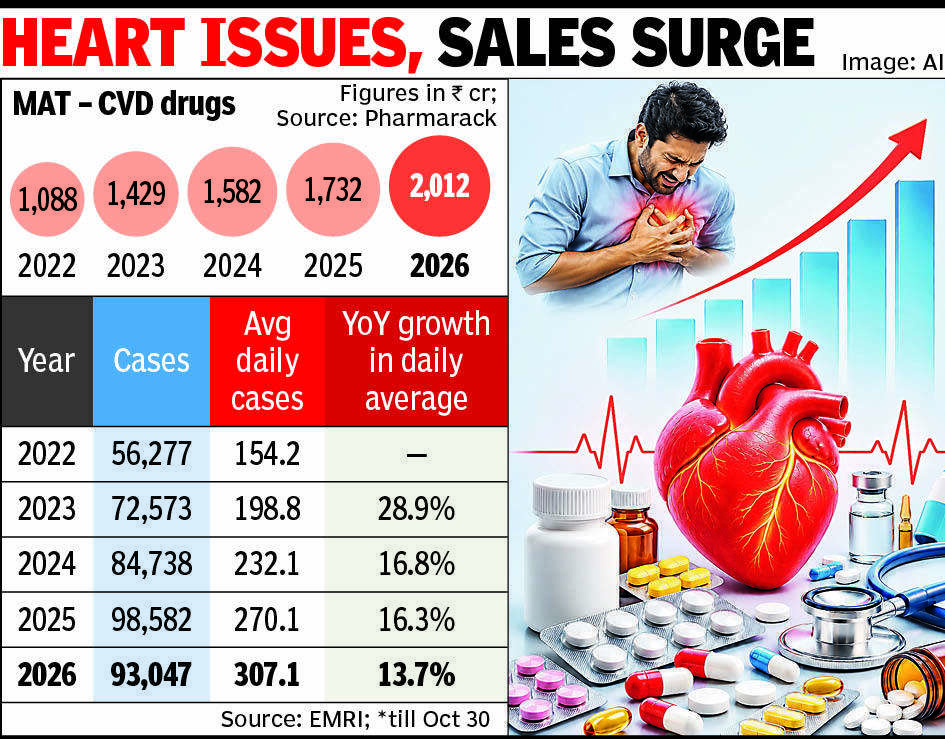
Ahmedabad: Gujarat’s cardiac therapy drug market crossed Rs 2,012 crore, expanding 85.3% in four years, amid a steady rise in cardiac emergencies across the state. The parallel trends point to a growing cardiovascular disease burden, with doctors increasingly reporting heart-related complications among younger people.According to Pharmarack, the market’s moving annual total (MAT) stood at Rs 2,012 crore in Oct 2026, up 16.2% year-on-year. The sales have grown consistently from Rs 1,088 crore in Oct 2022 to Rs 1,429 crore in Oct 2023, Rs 1,582 crore in Oct 2024 and Rs 1,732 crore in Oct 2025.The rise in medicine sales coincides with an increase in cardiac emergencies recorded by the Emergency Management and Research Institute (EMRI). Its data shows that cases rose from 56,277 in 2022 to 72,573 in 2023, 84,738 in 2024 and 98,582 in 2025.
Gujarat’s cardiac drug market beats Rs 2,000cr mark
Between Jan 1 and Oct 30, EMRI recorded 93,047 cardiac emergencies, already equivalent to 94.4% of the previous year’s total. The average daily caseload during this period was 13.7% higher than the 2025 average.Ahmedabad alone has reported more than 25,000 cardiac emergencies in first 10 months of 2026, accounting for over 20% of the state’s caseload, EMRI officials said.Greater health awareness and easier access to diagnostic facilities are also contributing to increased detection of cardiac risk factors, said Sheetal Sapale, vice-president (commercial) at Pharmarack. People are increasingly opting for routine health checks, while doctors are recommending basic screenings even during consultations for unrelated ailments, she said.Doctors, meanwhile, have flagged changing risk profiles, with hereditary predisposition, processed food consumption, obesity and air pollution contributing to cardiovascular complications.“We are seeing heart disease across age groups. Hereditary factors, unhealthy diets, obesity and exposure to high PM2.5 levels are contributing to the burden,” said Dr Amit Prajapati, a critical care specialist.An EMRI 108 analysis found that nearly three in 10 cardiac emergencies involved patients aged 40 or below.A separate study by the UN Mehta Institute of Cardiology and Research Centre involving heart attack patients aged 30 or below identified tobacco use (53%), inadequate physical activity (51%), frequent eating out or irregular meal timings (49%) and family history (31%) as major risk factors. Stress was reported by 28% of patients.A city-based cardiologist said heart complications, including heart attacks and non-STEMI cases, were increasingly being seen among younger patients. However, the emergency figures needed to be assessed alongside medical outcomes, the cardiologist cautioned.(With Inputs from Parth Shastri)