










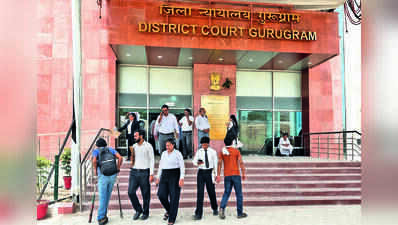
Gurgaon: Failure to join independent witnesses during the alleged recovery of a country-made pistol, the complainant doubling up as the investigating officer and a prosecution sanction granted without producing the weapon before the competent authority were among the reasons a Gurgaon court acquitted a man in an Arms Act case.Chief Judicial Magistrate Rajat Verma acquitted Yashbir, a resident of village Bada in Kherki Daula, holding that the prosecution had failed to establish the charges beyond reasonable doubt.According to the prosecution, on Aug 8, 2021, a police team led by ASI Sudhir Kumar was patrolling near Rampura Chowk when a secret informer tipped it off that Yashbir, alias Billa, was carrying an illegal weapon near his house. The police claimed to have apprehended him and recovered a country-made pistol from his possession. He allegedly failed to produce a licence or permit.The defence, represented by advocate Parveen Kumar Soni, argued that the alleged recovery was not supported by any independent witness and that there were material contradictions in the testimonies of police officials. The prosecution, represented by APP (additional public prosecutor) Paveen, maintained that the accused had been caught with an unlicensed firearm and deserved conviction.Accepting the defence’s submissions, the court noted that the entire prosecution case rested on police witnesses. Despite having sufficient time and opportunity, the investigating officer failed to associate any independent witness. The court observed that the IO had neither recorded the names of people he claimed to have approached in the case diary nor initiated any proceedings against them for refusing to join the investigation. It held that the explanation offered by the police was not convincing.The court also flagged a conflict of roles, noting that ASI Sudhir Kumar was both the complainant and the investigating officer. It observed that the investigation could not be considered free from bias.Another significant lapse concerned the sanction for prosecution. Although the sanction order issued by the Joint Commissioner of Police was placed on record, the court said merely exhibiting the document did not establish its validity. The prosecution failed to show that the firearm was produced before the sanctioning authority or that the authority had examined the relevant material before granting approval.Holding that the sanction appeared to have been granted mechanically, the court ruled that it could not be relied upon.Observing that the prosecution must stand on its own evidence and prove guilt beyond reasonable doubt, the court extended the benefit of doubt to Yashbir and acquitted him.