







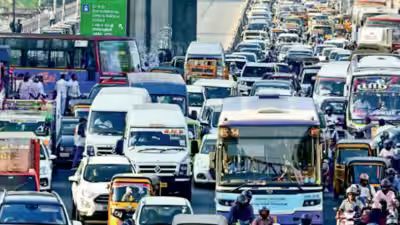
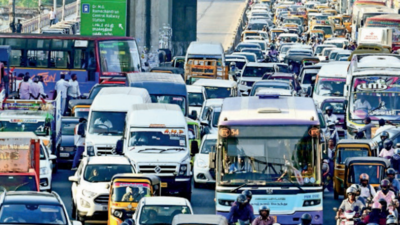
CHENNAI: Chennai could see a sharp rise in small commercial vehicles such as autorickshaws and vans by 2038 if bus services fail to keep pace with growing travel demand, according to a study by Anna University.The study projects the city’s vehicle growth under four scenarios. It says expanding metro rail connectivity will not complement public transport use unless supported by last-mile connectivity and feeder services involving MTC buses and small commercial vehicles. Experts said the government should incentivise public transport use through tax exemptions to reduce the number of personal vehicles on roads.The city’s bus fleet could increase from 36,584 in 2011 to 51,634 by 2038, while the number of small commercial vehicles could rise from 1,01,443 to 5,34,509, according to the study published recently in Sustainability.
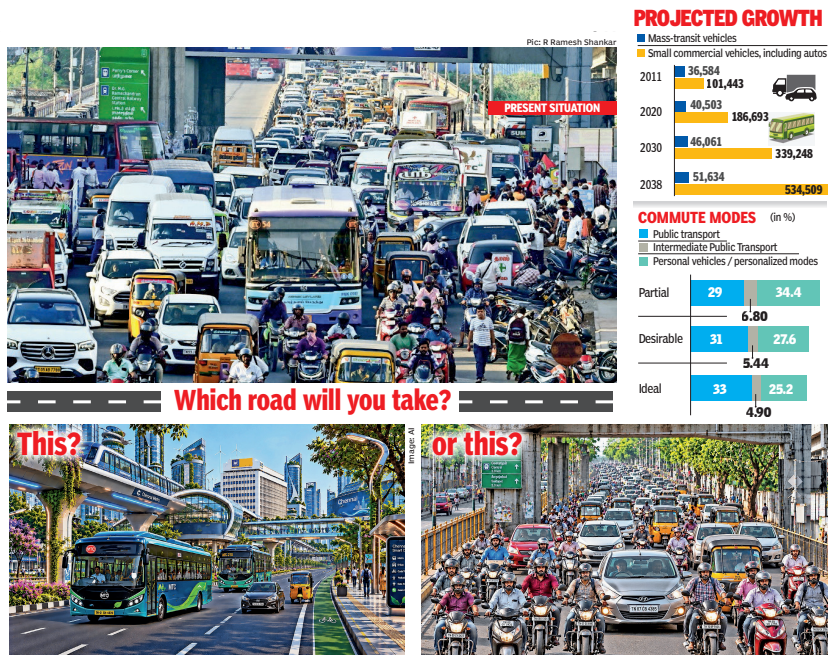
Which road will you take?
The research used a system-dynamics model to assess how population growth, travel demand, public transport expansion and vehicle technology could shape Chennai’s transport sector.This would mean more than 10 small commercial vehicles for every bus, even with metro rail connectivity. The widening gap could put more small and personal vehicles on the roads, increasing congestion, roadside parking and carbon emissions.The study examined four scenarios — minimum, partial, desirable and ideal — representing different levels of potential fleet expansion, clean-fuel adoption and integration of metro rail, buses and small commercial vehicles.Under the ideal scenario, an integrated network of metro rail, a larger bus fleet and small commercial vehicles providing last-mile connectivity could help public transport account for 33% of all trips by 2038. Intermediate public transport, including autos and share autos, could account for 4.9%, while personalised transport could fall to 25.2%.“These figures are broadly aligned with the Chennai Comprehensive Mobility Plan’s long-term target of a 33.5% public transport share,” said Rathiga Jeganathan, a research scholar at the College of Engineering, Guindy.By 2038, electric, hydrogen- and methanol-powered buses would form the mainstay of the fleet. Electric and solar-electric vehicles would phase out LPG autos and share autos.
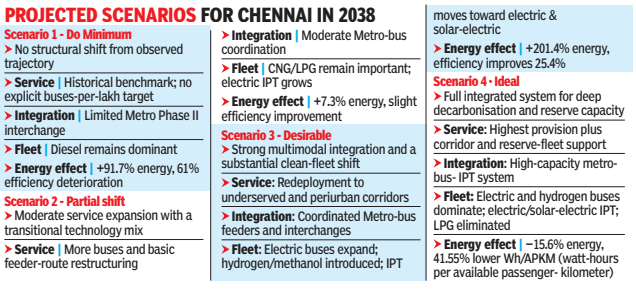
Projected scenarios for Chennai in 2038
The study recommends expanding MTC services, restructuring routes, integrating buses with Metro Phase II and improving feeder and last-mile connectivity.“Under the Ideal scenario, the number of buses should rise from 60 to 80 for every one lakh people,” said Dilibabu Ramalingam, a professor of Industrial Engineering at the College of Engineering, Guindy, and one of the study’s authors.The study identifies Anna Salai–Tambaram, Madhya Kailash–Siruseri and Broadway–Avadi as underserved corridors.“The govt should incentivise public transport use to reduce pollution,” said V Somasundaram, former chief general manager of CMRL.Without policy intervention, bus energy consumption could rise by 91.7% between 2011 and 2038, the study