








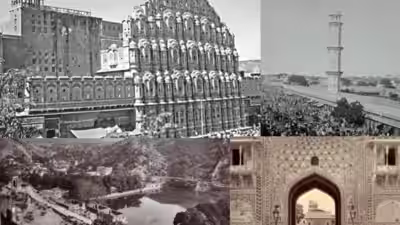
On Nov 18, 1727, under a shamiana filled with royals and loyalists, the foundation of Jaipur was laid at Gangapol. The day had been chosen as auspicious. The ritual was traditional, but the ambition behind it was extraordinary.Records preserved at Rajasthan State Archives in Bikaner describe a ceremony performed with a silver karchi, or trowel, and tagari, a shallow pan, invoking the blessings of Govind Dev Ji, the deity revered by the Kachhwaha rulers.As Jaipur completes 299 years and enters its 300th, that moment at Gangapol returns as more than a date in royal history. It marks the beginning of a city that Sawai Jai Singh II imagined not merely as a new capital, but as a planned centre of power, commerce and everyday life.
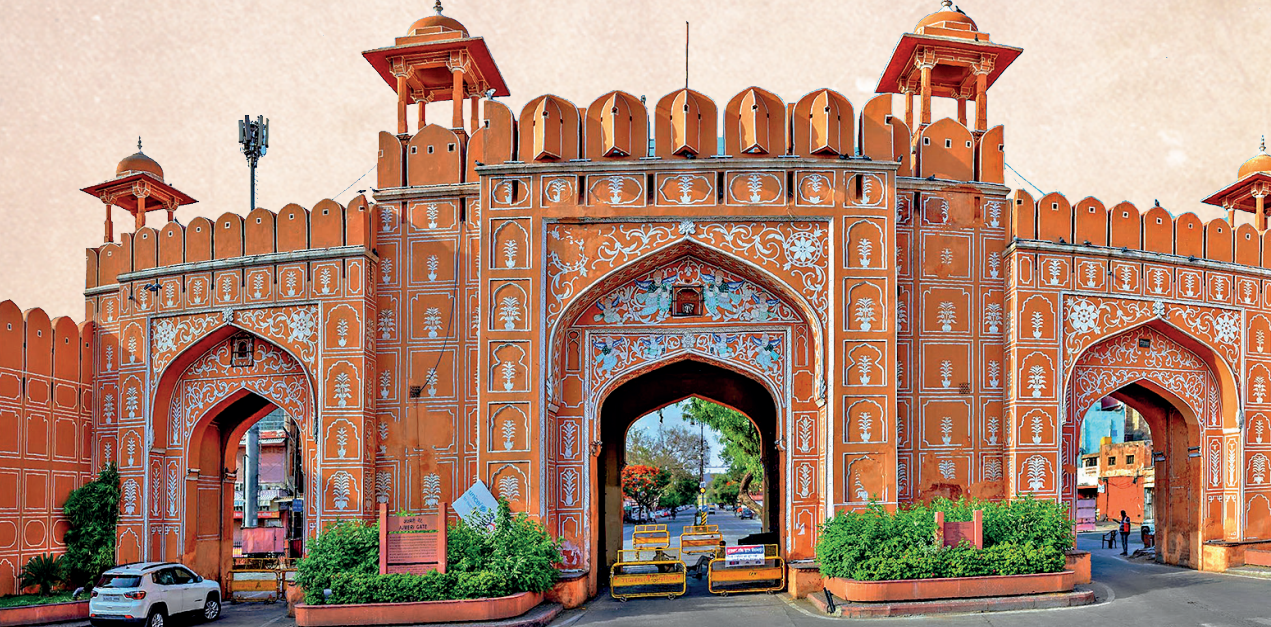
Ajmeri Gate in Jaipur
Jai Singh wanted a city that could absorb a growing population, support trade and function as an efficient administrative capital. The idea was not to let a settlement grow around power, but to design one where power, markets, movement and habitation had their place.According to Pankaj Sharma, former director of City Palace Museum, Jaipur, who conducted his doctoral research on the city before moving to Gujarat, the years between 1723 and 1727 were crucial to the planning of the new capital. Sharma, now director of Archaeology and Museums in Gujarat, said Jaipur’s design drew upon astrology, astronomy and Vastu, along with the mathematical principles and scientific practices of the time.Water availability, drainage, terrain and the possibility of future expansion were also carefully considered, he said.To turn his vision into a workable city plan, Jai Singh entrusted the task to Vidyadhar Bhattacharya. The plan followed a grid pattern, with broad roads meeting at right angles. The city was divided into nine sectors, known as chowkris. Large public squares, or chaupars, became important intersections, while markets and residential areas were organised within the layout, Sharma said.Bhattacharya’s contribution was recognised with royal honours. He was given a ceremonial robe of honour, or shiro-pao, and gifted an elephant named Motigarh. Sharma said a drawing of the elephant is preserved in the City Palace collection.But Jaipur was not built by geometry alone. Its making depended equally on people. Jai Singh invited traders, artisans and specialised craftsmen from different places, offering incentives such as free havelis and financial assistance to encourage them to settle in the new capital. The idea was to make Jaipur a living commercial centre, not just a seat of rule.“After establishing the Walled City of Jaipur, Maharaja Sawai Jai Singh II issued royal decrees inviting prominent figures and investors to settle in the region and build commercial hubs,” said Mahendra Jagdawat, former director of Rajasthan State Archives, Bikaner, who is currently posted as joint secretary in Labour Department.Nearly three centuries later, Jaipur still carries that founding imprint — in its gates and grids, in its bazaars and chowkris, and in the memory of a city that began with ritual but was built with planning, persuasion and purpose.