








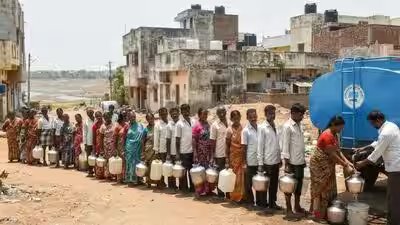
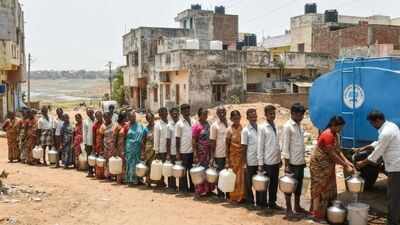
HYDERABAD: Come December, Hyderabad could find itself at the epicentre of a drinking water crisis, with El Nino conditions threatening to push its key reservoirs, Singur and Manjeera, close to running dry. The city’s daily water deficit could exceed 1,000 MLD, up from the existing shortfall of nearly 600 MLD, making Hyderabad one of the worst-hit metros in the country.The two reservoirs together supply 480 MGD of water, accounting for nearly 20% of Hyderabad’s total supply of 2,600 MLD. The city’s estimated daily demand, however, stands at 3,200 MLD.In comparison, Bengaluru is estimated to face daily deficits of 500 to 600 MLD amid the El Nino effect, while Mumbai’s shortfall is pegged at around 500 MLD, according to various reports. Delhi, like Hyderabad, is staring at a deficit of 1,000 MLD. However, the capital has recorded 14% excess rainfall this season, offering some cushion against the looming crisis.Besides, Delhi’s water deficit is a long-standing problem, prompting authorities to put multiple contingency measures in place to manage peak demand. According to the Delhi Jal Board, these include emergency supply networks, wastewater recycling and groundwater extraction through tube wells across the city, particularly along the Yamuna and Ganga.Hyderabad, meanwhile, is facing a different challenge. The city’s CURE area – including Rangareddy, Medchal-Malkajgiri and Hyderabad – has received around 240 mm less rainfall than usual this year, translating into a 33% deficit.The already wide demand-supply gap has also widened suddenly, catching authorities off guard.Adding to the concerns, experts say that rainfall in the catchment areas of Hyderabad’s reservoirs has been considerably lower than in those supplying Mumbai and Delhi this season.“That makes Hyderabad more vulnerable, particularly as summer approaches and groundwater extraction becomes increasingly difficult,” said an official from the National Environmental Engineering Research Institute (NEERI). He added: “The situation could become particularly critical from Feb onwards, when groundwater availability is expected to dip sharply.”The city’s reservoirs are already under considerable stress, with storage levels at Singur at 7%, Manjeera at 17%, Osmansagar at 54% and Nagarjunasagar at 57%. Mumbai, in contrast, is in a relatively comfortable position. The city has seven major drinking water sources, including Bhatsa and Modak Sagar. Official records show that they together hold over 80% of their storage capacity, following rainfall of around 2,500 mm this monsoon, against the normal 2,490 mm.Experts say that healthy storage levels should help the Maharasthra capital tide over the summer, despite the El Nino effect, and sustain supplies for the next seven to eight months.Bengaluru, too, has a relatively better reservoir buffer. The Krishna Raja Sagara Dam in Mandya district and other reservoirs in the Cauvery basin together have around 50% of their storage capacity, according to available estimates. Also, each of the reservoirs can service any part of the city, unlike Hyderabad.“While Hyderabad faces the prospect of 3.5 lakh consumers in its IT corridor, who are entirely dependent on Manjeera, being left with dry taps as early as next month, Bengaluru might still see some supply reaching its most critically affected pockets, such as Bommanahalli and Chickpet. This is because the city has several other pumping stations drawing water from the Cauvery and supplying different parts of the city,” said a water management expert from Bengaluru. Experts fear Hyderabad’s situation could persist right up to April.“The period between Dec and April is expected to see very little rainfall. Given that Hyderabad, which normally receives 800-900 mm of annual rainfall, has received nearly 40% less this year, the dry spell could further affect its drinking water availability,” said a professor at the IISc.Water board officials say they have rolled out emergency measures to tackle the crisis while drawing up longer-term plans to address the shortfall. An additional 40 MGD (180 MLD) is proposed to be sourced from the Godavari to compensate for the shortage, while another 45 MLD will be made available by adjusting supplies from the Krishna source.