










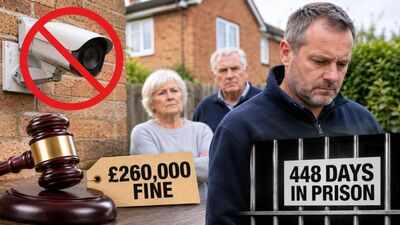
A long-running dispute between neighbours in East Sussex resulted in a homeowner being ordered to pay £260,000 in damages and remove cameras overlooking the neighbouring property. However, the conflict continued even after the court imposed restrictions on his behaviour. Mark Gary Coates repeatedly breached the orders and was charged with a second contempt of court and sentenced to 448 days in prison. In June 2025 the Court of Appeal dismissed his challenge to the sentence, ruling the punishment meted out by the lower court was justified.
Why the UK homeowner was ordered to pay £260,000
The dispute was between Mark Gary Coates and his neighbours, Janice Elizabeth Turner and Brian David Abernethy Greenwood. The row concerned property boundaries and involved claims of harassment under the Protection from Harassment Act 1997.The neighbours took legal action against Coates and his wife [Court of Appeal judgment Turner and another v Coates (2025)]. Her Honour Judge Venn of the County Court at Hastings ruled in the claimants’ favour after a 5 day trial on 22 September 2022.Coates was ordered to pay £260,000 in damages, plus costs. It also imposed a number of restrictions on his conduct including removing items placed on a neighbouring track and refraining from threatening behaviour toward the claimants.One of the key requirements was the removal of cameras and video equipment that had a view of the neighbours’ property. Coates was also prohibited from filming, photographing or making audio recordings of the neighbours or their visitors.
How did the dispute lead to the first prison sentence
The restrictions did not bring the dispute to an end. Coates breached several of the court’s orders, prompting his neighbours to bring the first contempt of court proceedings against him.The case was heard on 26 October 2023, after an earlier hearing had been postponed to allow Coates to obtain legal aid and legal representation. However, his solicitors stopped representing him shortly before the hearing, leaving him to defend himself.Judge Venn found several allegations proven and sentenced him to 252 days in prison for contempt of court.Coates subsequently challenged the sentence at the Court of Appeal. In December 2023, the appeal judges upheld the findings of contempt, apart from one ground, but ruled that the prison term was too long. They said a sentence of approximately 3 months would have been appropriate and ordered his immediate release, taking into account the time he had already spent in custody.However, the court also made clear that any further breaches of the injunctions could result in a substantial prison sentence.
What happened before the second contempt case
The dispute continued into 2024 with the financial orders made against Coates remaining unsatisfied. On 14 March 2024 a charging order was placed on his and his wife’s home, with the order being for the property to be sold. If the outstanding financial obligations were not met, the sale was scheduled to take place in June.Turner and Greenwood filed a second contempt application on April 17, 2024, claiming that Coates had continued to breach the original injunctions. The allegations range from April 19, 2023 through June 10, 2024 and include harassment, intimidation and property damage.The Court of Appeal judgment recorded several serious incidents. These included throwing stones at Turner, injuring her hand, breaking a greenhouse window and damaging Greenwood’s car window. Coates was also accused of making a throat-slitting gesture towards Turner, driving his van towards Greenwood in an attempt to run him over, filming Turner and threatening to kill the neighbours.The situation escalated on 10 June 2024, just three days before the deadline for the sale of his home. Coates began destroying parts of his own property, threw roof tiles at Turner from his roof and crossed onto the neighbours’ roof, where he removed and damaged tiles.
The court arrived at the 448-day prison sentence
The second contempt hearing took place on 17 September 2024. Judge Venn considered 20 alleged breaches and found 19 of them proven, including all four of the particularly serious incidents highlighted in the appeal judgment.The judge calculated individual prison terms for the proven breaches, amounting to 546 days. She decided that the sentences should run consecutively because the incidents were separate acts rather than a single continuous event.After considering the overall punishment and applying the totality principle, she reduced the combined sentence to 448 days, equivalent to 64 weeks.Meanwhile, Coates was also facing criminal proceedings involving some of the same incidents. He had been charged with dangerous driving, harassment and criminal damage and was remanded in custody in July 2024.At his criminal trial on 29 November 2024, he was convicted of criminal damage to both his own home and the neighbours’ property but acquitted of the harassment charges. In March 2025, he received a four-year and 16-week prison sentence for criminal damage, with another three-year sentence running concurrently.
The Court of Appeal rejected his challenge
Coates appealed the 448-day contempt sentence on two grounds. He argued that the civil proceedings should have been postponed until the criminal case was concluded because both involved overlapping allegations. He also argued that the prison terms for the separate breaches should have run concurrently rather than consecutively.However, in its judgment handed down on 25 June 2025, the Court of Appeal dismissed both arguments.Lord Justice Birss, sitting with Lord Justice Zacaroli, said civil contempt proceedings and criminal cases have different objectives. Civil contempt proceedings are intended to protect the dignity of the court and to compel compliance with its orders. This means they are not automatically required to wait for the conclusion of related criminal proceedings.The judges also noted that a person being acquitted in a criminal trial does not automatically make an earlier civil contempt finding unjust. The two proceedings can involve different evidence and legal considerations. The criminal sentencing judge had also taken the earlier contempt sentence into account when deciding the punishment for the criminal offences.On the question of consecutive sentences, the appeal court found that Judge Venn had been entitled to treat the breaches as separate incidents.