








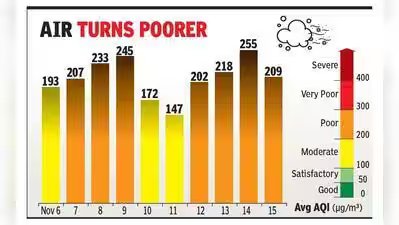
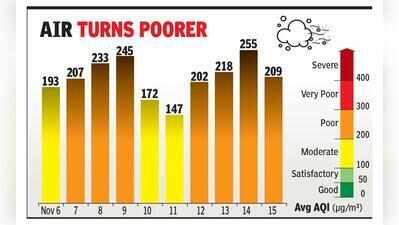
Lucknow: City hospitals are witnessing a surge in patients reporting breathlessness, chest heaviness, throat irritation and persistent dry cough, with doctors attributing the spike to prolonged exposure to polluted air.At RMLIMS, OPD and emergency visits for acute respiratory distress have risen by about 15% during the current pollution spell, said Prof Ajay Kumar Verma, head of respiratory medicine.Of the department’s nearly 300 daily patients, 60-65% have asthma or chronic obstructive pulmonary disease (COPD) and are experiencing flare-ups, while 35-40% are reporting new complaints such as throat irritation, acute bronchitis and pollution-induced airway inflammation, he said.At Max Super Specialty Hospital, pollution-related OPD cases have increased by 30-40% over seasonal levels, according to Dr Sunil Verma, director of internal medicine. He said he sees about 200 patients daily.“Many patients have burning sensation in the throat, chest heaviness and a persistent dry cough, but no fever or phlegm. A large number of them travel daily on two-wheelers, work outdoors or live near busy traffic corridors,” he said.At ApolloMedics Hospital, pulmonary OPD attendance has increased from about 30 patients a day to 50-60, said consultant pulmonologist Dr Shubham Agarwal.The rise coincides with deteriorating air quality in the city. According to Central Pollution Control Board (CPCB), Lucknow’s AQI increased from 188 on Nov 5 and 193 on Nov 6 to 207 on Nov 7, 233 on Diwali and 245 on Nov 9. It improved to 172 on Nov 10 and 147 on Wednesday before rising to 202 on Thursday, pushing air quality back into the poor category.Doctors said pollution-related coughs are typically dry and accompanied by irritation of the eyes, nose and throat. Viral infections are more likely to cause fever, body ache, sneezing and sore throat, while bacterial infections may produce high fever and yellow or green sputum.“Patients should not assume that every cough requires an antibiotic. In the absence of fever and phlegm with irritation of the eyes, nose and throat, pollution is more likely to be the trigger,” Dr Verma said.Prof Verma said PM2.5 and PM10 particles can penetrate deep into the lungs and trigger inflammation, bronchospasm and swelling, leading to wheezing, breathlessness, chest tightness and reduced oxygen saturation.Doctors identified senior citizens, children, newborns, daily two-wheeler commuters and traffic personnel among the most vulnerable groups. They said people with asthma, COPD, heart disease, diabetes and hypertension require closer monitoring during pollution episodes.Doctors are also seeing complaints of headaches, fatigue, poor concentration and mental fog.Dr Verma said exposure to high PM2.5 levels and carbon monoxide can contribute to blood pressure fluctuations, increased heart rate and chest discomfort, particularly in people with cardiovascular disease.Pulmonologists advised against self-medication with antibiotics. They asked asthma and COPD patients to continue prescribed controller inhalers and keep rescue inhalers readily available.Residents experiencing breathlessness, chest pain, severe wheezing, high fever or falling oxygen saturation should seek medical attention immediately, doctors said.