







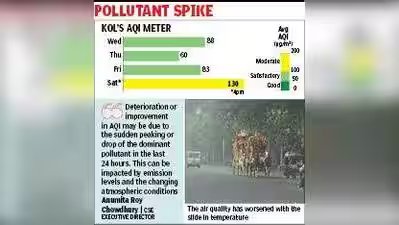
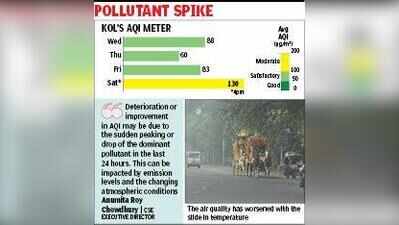
Kolkata: The city’s AQI — the average air quality of all seven monitoring stations — dropped to “moderate” on Saturday after remaining “satisfactory” between Wednesday and Friday. According to environment scientists, the downslide was likely to continue with the approaching winter.Scientists said a sharp spell of rain on Tuesday evening washed away the accumulated pollutants from the air and improved the city’s AQI but they again amassed over the next few days. As mercury slides, AQI levels will also drop, an annual phenomenon in Kolkata and elsewhere in the country, admitted a state pollution control board (PCB) official. Sporadic rains may improve the pollution meter for a day or two, but it will not endure.At 3 pm on Saturday, the AQI of Kolkata was 130, which is moderate. It was 83 on Friday, 60 on Thursday and 88 on Wednesday. According to Central Pollution Control Board (CPCB), the range 50 to 100 means “satisfactory” air quality.Good air quality has “minimal impact” on health, satisfactory can lead to “minor breathing discomfort to sensitive people”, and moderate air quality can cause “breathing discomfort to the people with lungs, asthma and heart diseases”.Individually, all the seven monitoring stations of Kolkata also reported “moderate” air quality for most of Saturday.“Kolkata received a sharp spell of rain on Tuesday evening. Rain helps wash away pollutants, and AQI readings instantly improve. This is one of the reasons why air quality remains good during monsoon as frequent rain washes away pollutants,” said an environment scientist.“Deterioration or improvement in AQI may be due to the sudden peaking or drop of the dominant pollutant in the last 24 hours. This can be impacted by emission levels and the changing atmospheric conditions,” said Anumita Roy Chowdhury, the executive director of Centre for Science and Environment (CSE). The lower temperature during autumn and winter aids pollutants to remain in the air for longer. As wind speed also dwindles during this time, the pollutants do not disperse quickly like in summer or monsoon.Environment scientists said there is fear of a further spike in pollution levels in the coming days if there is firecracker bursting during Chhath Puja celebrations. This year’s Diwali has been among the worst in many years. The state pollution control board received the maximum number of complaints during Kali Puja and Diwali this year.On the night of Diwali, AQI had dropped sharply at night after hours of cracker bursting that released large volumes of pollutants in the air that then hung in the air because of lower temperature.