
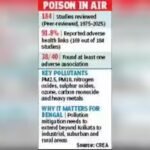







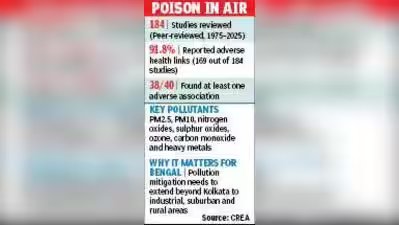
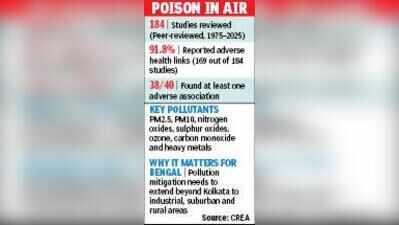
Kolkata: More than nine out of every 10 epidemiological studies conducted in India over the past five decades have established an association between air pollution and adverse health outcomes, according to a comprehensive scientific review released on Friday. Bengal, with 10 studies, ranks fifth among states and Union Territories in the geographical distribution of research, underscoring the growing body of evidence linking polluted air to public health risks in the state.The systematic review by Centre for Research on Energy and Clean Air (CREA), covering 184 peer-reviewed studies published between 1975 and 2025, found that 169 — nearly 92% — reported increased health risks associated with exposure to air pollution.The findings assume particular significance for Kolkata, where particulate pollution routinely worsens during winter, exposing residents to elevated concentrations of fine particles. They also reinforce concerns that pollution control measures cannot remain confined to Kolkata and other major cities but must encompass industrial belts, neighbouring districts and rural Bengal.Bengal accounted for 10 studies, behind Delhi (26), Punjab (13), Maharashtra (11) and Uttar Pradesh (11). Tamil Nadu followed with nine studies, Karnataka eight and Telangana seven.Significantly, the evidence was not limited to independently funded research. Of the 46 govt-funded studies examined, 44 reported adverse health associations. Similarly, 77 of 81 studies involving govt-affiliated institutions identified increased health risks.The institutions associated with the research included Indian Council of Medical Research, Central Pollution Control Board, AIIMS and several central ministries and scientific organisations.Respiratory diseases emerged as the most frequently investigated health outcome, featuring in 86 studies, followed by mortality (16) and cardiovascular diseases (11). Researchers also examined diabetes, pregnancy complications, low birth weight, impaired child growth and neurocognitive disorders, among other conditions.Importantly for Bengal, where pollution concerns extend beyond Kolkata to industrial and rural regions, 38 of 40 studies examining rural populations reported at least one adverse health association.“The findings highlight the need to move beyond a city-centric approach and explicitly include rural areas through a regional, airshed-based approach in the next phase of National Clean Air Programme (NCAP 2.0),” said Manoj Kumar, analyst at CREA.The review also challenges the tendency to focus predominantly on particulate pollution. Apart from PM2.5 and PM10, researchers investigated gaseous pollutants, including nitrogen oxides, sulphur oxides, ozone and carbon monoxide, which were associated with respiratory emergencies, asthma admissions, impaired lung function and mortality.These gases also contribute to the formation of secondary fine particles. Sulphate and nitrate particles, formed through atmospheric reactions, account for approximately a quarter of India’s PM2.5 concentrations.For Bengal, the findings strengthen the case for tackling emissions from vehicles, industries, power plants and household combustion simultaneously, rather than relying exclusively on city-level interventions.“Air pollution mitigation must adopt a multipollutant approach,” Kumar said, calling for PM2.5-specific targets under a revised NCAP and up.