










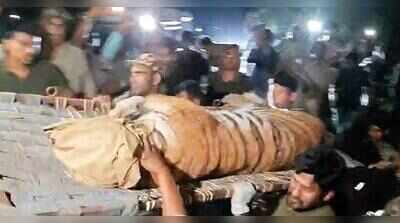
Kolkata: The Buxa tigress, which was brought over from Valmiki Tiger Reserve on Sept 30, was about two months pregnant, the Bengal forest dept learnt on the night of Nov 7, triggering questions over how her condition went undetected despite three rounds of tranquillization — on Sept 29, Oct 1 and Nov 3 — and whether adequate health checks were carried out before and after her translocation from Bihar to Bengal.The tigress had wandered off just two days after her Oct 2 release and reached Assam on Oct 23, from where she was brought back to Buxa on Nov 3. She suffered a miscarriage on Nov 7 night, sources said. The day after, she remained agitated and aggressive and escaped in the afternoon by “digging under the fencing of her enclosure”.Bengal forest department has constituted a probe panel to examine how a pregnant tigress was selected for the Buxa tiger reintroduction project as well as alleged lapses in the construction of the enclosure that she breached.“A central team is also probing what happened right from the time of capture. We released the tigress after getting a ‘fit certificate’. I don’t know about the foetuses or if at all there was any foetus. We will comment only after getting a report from the central team,” state forest minister Manoj Kumar Oraon said.Valmiki field director Gaurav Ojha said his team’s responsibility was limited to locating, capturing and handing over the tigress to the Bengal forest department. “Beyond that, our role ends. Pregnancy in a tigress is detectable in the wild only at an advanced stage. I understand the foetuses were abut two months old, which would mean they were barely 15-20 days at the time of capture. Detecting pregnancy at such an early stage in the field would have been extremely difficult,” he said.In another serious lapse, sources said the written approval from National Tiger Conservation Authority (NTCA) for the third tranquillization allegedly had not reached field officials in Assam when the tigress was captured on the edge of Raimona National Park.The discovery of the slip-ups come barely two days after an expert-chaired NTCA meet flagged concerns over the “hurried” release of the tigress which had injured herself during the 17-hour transportation by road and air from Valmiki to Buxa between Sept 29 and 30.The tigress, sources said, is still within the limits of Buxa forest and killed a wild boar on Thursday morning. NTCA member secretary Sanjay Kumar Pathak & NTCA IG Sanjayan Kumar are in Buxa to asses the situation while assistant IG Sajid Sultan will reach on Friday.Retired IFS officer and former Panna Tiger Reserve field director R Sreenivasa Murthy said the tiger reintroduction project appeared to have been implemented in haste.“There have already been three tranquillizations. Besides, there were reported injuries during her transportation from Valmiki. The release should have been deferred and she should have been kept under observation,” he said. “The other issue is managerial monitoring. During the Panna reintroduction, the entire monitoring was handled by our forest staff. I don’t know whether Buxa has adequate staff or the required training to handle this. We must take lessons from the failures at Satkosia,” he added.Recalling a similar situation during Panna’s reintroduction, which began in 2009, Murthy said they had avoided tranquillizing a tigress to prevent a miscarriage and continued monitoring her instead. She eventually delivered, becoming the world’s first rewilded tigress to achieve breeding success, he said.Conservation biologist Raghunandan Singh Chundawat said the experience of the team involved in the operation needed scrutiny. “It must be established how the tigress was selected and whether the team knew she was pregnant. If they did, why was she tranquillized three times? Escaping from the enclosure is gross negligence,” he said.Former Wildlife Institute of India dean Y V Jhala said detecting early pregnancy in a wild tigress is difficult. “However, post-capture monitoring and observation after translocation could help,” he said.