









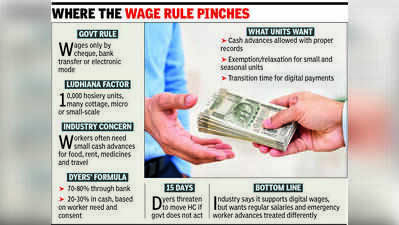
Ludhiana: A Punjab govt move requiring factories and establishments to pay wages only through cheque, direct bank credit or electronic modes has put Ludhiana’s small-industry sector on edge, with hosiery and dyeing associations arguing that a blanket ban on cash payments could make it difficult to provide workers small advances for everyday emergencies.The Knitwear Club and Punjab Dyers Association have approached the state govt seeking a rethink of the notification, particularly for cottage, micro and small units. While backing digital payment of regular wages, they have sought flexibility for cash advances that workers frequently take for food, rent, medicines, transportation and other immediate needs.The issue assumes significance in Ludhiana, where Knitwear Club chairman Vinod Thapar said there were around 10,000 hosiery units, a substantial number of them operating in the cottage, household, micro and small-scale segments.In a representation to the state labour minister, Thapar said many workers in these units were unskilled, semi-skilled or migrants and depended on daily or weekly earnings. Small advances were frequently provided by employers and subsequently adjusted against wages.The industry maintains that routing every such small payment through banks or electronic modes could cause practical difficulties, particularly where workers have limited access to digital payment facilities. Frequent small transactions would also have to be reconciled by establishments with limited administrative infrastructure, it said.Thapar said the industry was not opposing digital wage payments. Instead, it wanted the govt to distinguish between regular wages and interim advances given to workers against their earnings.Industry representatives also fear that removing this flexibility could make it more difficult for small units to retain workers, particularly when employees require money at short notice.The Punjab Dyers Association has separately written to the chief minister and labour minister, raising questions over the notification. The association maintained that the Code on Wages provides for different modes of wage payment and sought a review of the state’s order.It has sought withdrawal of the notification or exemptions for seasonal industries such as hosiery, dyeing, knitting, garments and processing.As an alternative, the association has proposed a 70:30 or 80:20 formula, under which 70% to 80% of wages could be transferred to workers’ bank accounts while the remaining 20% to 30% could be paid in cash depending on workers’ requirements and consent.The association has warned that it would approach the Punjab and Haryana High Court through a writ petition if the govt does not take steps within 15 days.Industry bodies have also suggested allowing limited cash advances against written acknowledgements and proper records. They have sought a reasonable transition period, a simplified system for adjusting advances against wages and consultations with industry and labour representatives before uniform implementation.They maintained that greater transparency in wage payments was welcome, but said compliance should not leave small businesses struggling with additional paperwork or prevent workers from accessing money when they need it urgently.