







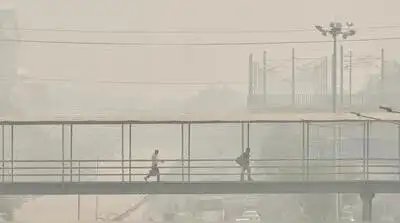
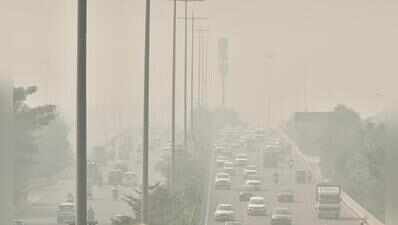
Gurgaon: Air pollution in the city remained elevated for two days after Diwali, with PM2.5 levels on the second day rising nearly 70% from last year, according to a comparison of festival-period data over the past decade.PM2.5 concentration stood at 184 micrograms per cubic metre (µg/m³) on the second day after Diwali, compared with 108 µg/m³ in 2025 and 112 µg/m³ in 2024. The level, however, was lower than the 205 µg/m³ recorded on the same day in 2023.A day after Diwali, PM2.5 was recorded at 213 µg/m³, down from 242 µg/m³ in 2025 but higher than 153 µg/m³ in 2024. This year’s reading was also below the 282 µg/m³ recorded on the corresponding day in 2023.The concentration declined by about 14% between the first and second days after Diwali, from 213 µg/m³ to 184 µg/m³. Even so, the second-day level was 23% higher than the Diwali-day concentration of 150 µg/m³.PM2.5 refers to particles that are 2.5 microns in diameter, about one-thirtieth the width of a human hair. These fine particles can penetrate deep into the lungs and enter the bloodstream when inhaled. Prolonged exposure can aggravate or trigger cardiac and respiratory illnesses.Explaining why pollution remains high after Diwali, air analyst at CREA Manoj Kumar said atmospheric mixing conditions determine how quickly pollutants disperse.“During the afternoon, the boundary-layer height, or mixing-layer depth, was at its highest. So, whatever crackers are burst in the morning gets dispersed during the day. But the mixing-layer height reduces at night, leading to lower atmospheric dispersion and accumulation of pollutants. When crackers are burst in the evening, pollution keeps accumulating, with concentrations generally peaking between midnight and early morning, around 1am to 5am,” he said.He said the reduction in mixing-layer height at night limits the vertical movement of pollutants, allowing emissions to build up closer to the ground and affect pollution readings the next morning.A decade-long comparison shows the highest post-Diwali PM2.5 concentrations were recorded in 2021, when levels reached 439 µg/m³ on the first day after Diwali and 363 µg/m³ on the second day. This year’s readings were below the 2017-2025 averages of 263.6 µg/m³ for the first day after Diwali and 184.2 µg/m³ for the second day.The figures do not establish the share of pollution caused by firecrackers, stubble burning or other emission sources. Weather factors, including wind speed, wind direction and mixing-layer height, also affect the accumulation and dispersal of pollutants.