









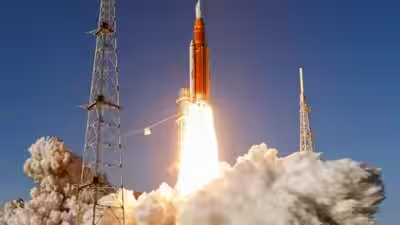
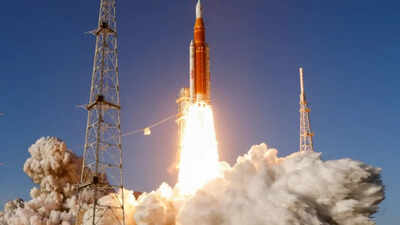
NASA’s Artemis II mission has caused major disturbances in Earth’s ionosphere. Researchers studying the April launch identified two elongated regions of reduced electron density stretching roughly 5,000 kilometres from east to west across North America. According to a Space.com report, researchers have described them as resembling giant contrails. However, these “holes” were temporary changes in the electrically charged upper atmosphere, rather than permanent openings.The findings raise questions about how powerful rocket launches and subsequent engine firings affect satellite navigation. Taiwan’s National Cheng Kung University team reconstructed the disturbances using ground-based GPS observations. The research describes three separate mission-related events that could affect technologies that depend on accurate positioning. But it does not prove that vehicles or drones experienced navigation failures.
What caused the two atmospheric holes
One disturbed region followed the passage of the Space Launch System rocket’s core stage. The report claimed that the other was associated with two subsequent engine burns by its upper stage.The researchers examined the initial launch, an apogee boost burn that adjusted the spacecraft’s orbit, and the trans-lunar injection manoeuvre that sent it towards the Moon. These produced disturbances over the same broad geographical region on three occasions.“The total electron content observations during the Artemis-II Lunar mission revealed rare recurring ionospheric perturbations on three different occasions,” the researchers wrote.The work is available as a preprint associated with a submission to Geophysical Research Letters. This means that it should therefore be distinguished from a confirmed, peer-reviewed journal publication.
Why changes in the ionosphere matter for GPS
The ionosphere contains free electrons and electrically charged particles that affect radio signals passing through it. GPS receivers calculate their position using signals transmitted by satellites, so changes along those signals’ paths can introduce positioning errors.The researchers used measurements from fixed ground receivers to monitor changes in electron content during the mission. Such disturbances may temporarily degrade positioning accuracy, but the practical implications have not yet been studied.“A positioning error of a couple of meters is enough to cause an autonomous car to change lanes,” study co-author Charles Lin, an earth science professor at National Cheng Kung University, told Space.com. “It could have a strong impact not only on self-driving cars but also on drone positioning.” His comments describe possible consequences of positioning errors, rather than documented incidents caused by Artemis II.
What researchers want to examine next
The findings suggest that engine burns performed after launch also deserve attention when assessing rockets’ atmospheric effects.“These findings prove orbital manoeuvre burns performed within the ionosphere as a distinct and repeatable source of anthropogenic space weather, beyond the well-established launch-stage disturbances,” the researchers wrote. Anthropogenic space weather refers to human-caused disturbances in the near-Earth space environment.The team called for further study of the effects on satellite navigation and high-frequency communications, including how the disturbances develop and how long their effects last.