










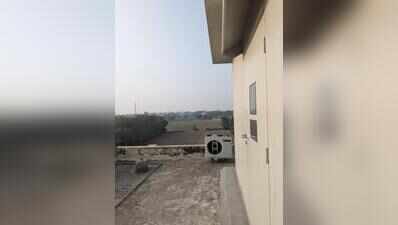
Ghaziabad: Automated monitoring stations in the city are reporting relatively satisfactory pollution levels even as readings from several private air-quality monitors indicate severe pollution.One reason for the discrepancy could be the location of the Govindpuram monitoring station, which is situated amid agricultural fields, away from traffic and residential areas, potentially pulling down Ghaziabad’s average pollution readings.The monitor sits on the rooftop of a sewage treatment plant (STP), about 50 feet above the ground. It overlooks the plant’s water reservoir on one side and a vast open agricultural field on two others. A narrow passage on the fourth side is used only by vehicles heading to the plant.The station stayed in the ‘moderate’ category on most of the last 10 days, with an AQI of 67 (satisfactory) on Nov 1. The only exception was Nov 9, the day after Diwali, when the reading peaked at 323 in the ‘very poor’ category.Wave City and Loni stations, in contrast, consistently recorded ‘poor’ to ‘very poor’ air. Wave City’s AQI peaked at 357 on Nov 9, while Loni touched 371 on Nov 8. Govindpuram improved sharply to 171 on Nov 10.The station’s AQI also stayed considerably better than the city averages of Noida and Ghaziabad between Nov 2 and 10. The station recorded an average AQI of 191 over the nine days, against 309 in Noida and 277 in Ghaziabad. On Nov 2, it logged an AQI of 112 (‘moderate’), compared with 330 (‘very poor’) in Noida and 289 (‘poor’) in Ghaziabad. Its reading stayed below both city averages on all nine days, though the gap narrowed sharply on Nov 9, when it recorded 323 against Ghaziabad’s 324 and Noida’s 332. On Nov 10, Govindpuram’s AQI was 171, while Noida and Ghaziabad recorded 301 and 244, respectively.Operation in-charge Pankaj Yadav said the air stays largely clear because of the open space and surrounding trees. “Mechanical sweeping machines are not used in the area, though after Diwali an anti-smog gun was operated on Tuesday,” he said.Uttar Pradesh Pollution Control Board (UPPCB) regional officer Ankit Singh said the Govindpuram station was set up to give a fair idea of pollution levels across a wide range of settings. “We ensure that the monitoring stations record ambient air quality of different regions like commercial hub, industrial area and heavy traffic zones so there should be one station in cleaner and open area to have an idea of the air quality,” he said.Environmentalist Amit Kumar Gupta, who filed the complaint with the UPPCB and the Integrated Grievance Redressal System (IGRS), said the station was recently calibrated and there appeared to be a fault in the calibration. “UPPCB has agreed to review the data and re-calibrate the sensors because there is a notable difference in the felt air quality and what is being reflected in the monitor,” he said.