









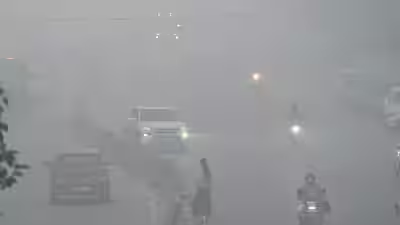
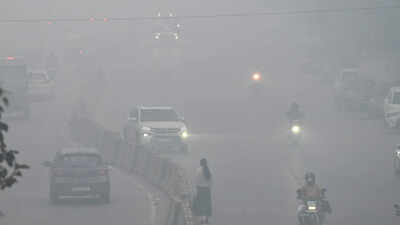
DELHI: For the second Diwali in a row, the mysterious disappearance of data from air quality monitoring stations across Delhi during peak pollution hours has raised questions about the reliability of the govt’s AQI figures.The official average AQI of 344 on Monday makes this the second-cleanest Diwali on record among years when the day after the festival fell in Nov. But the picture changes significantly when the missing data is factored in.TOI’s calculations show that the average AQI could have exceeded 370 had the large-scale data outage not occurred, with all other factors remaining unchanged.Three aspects of the outage, which began on Sunday night, stand out.First, data from the previous day shows no disruption on anything approaching the scale witnessed on Diwali night, according to hourly AQI readings downloaded from the CPCB website, which provides station-wise data for the city.Second, most of the outage occurred between 10pm on Diwali night and 10am on Monday, when air quality was at its worst because of firecracker emissions.Of the 43 monitoring stations that reported missing data for at least an hour, 39 went off the grid after their readings had touched the maximum AQI of 500. 38 of these stations were still recording an AQI of 500 when data transmission resumed.
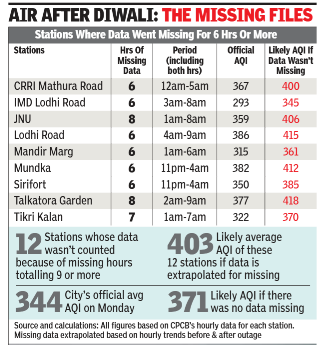
Air after Diwali: The missing files
A total of 247 hours of data went missing during this 12-hour window, averaging more than four hours for each of Delhi’s 59 monitoring stations. Outside this period, after 10am on Monday, the total data loss was barely 14 hours.Third, 12 monitoring stations recorded data outages of nine hours or more, crossing the threshold beyond which a station is excluded from the calculation of the city’s daily average AQI.Hourly readings from all 12 stations show that they were recording an AQI of 500 when the outage began and continued to do so when data transmission resumed.The only exception was the Jawaharlal Nehru Stadium station, which recorded an AQI of 403, still in the ‘severe’ category, when transmission resumed at 10am after a nine-hour gap.This suggests that readings at these stations would likely have remained at or near 500 had there been no interruption in data transmission. Extrapolating from the available readings, the average AQI for the 12 stations excluded from the citywide calculation works out to 403, indicating that they were among the worst-affected pollution hotspots.Similar extrapolations for stations with shorter data outages during peak pollution hours suggest that as many as 13 monitoring stations may have recorded 24-hour average AQI levels in the ‘severe’ category, compared with just one in the official figures. Another eight stations are likely to have recorded AQI levels above 390, close to the severe threshold.It must be emphasised that these calculations are indicative estimates intended to account for substantial gaps in the available data. They do not represent definitive AQI readings.