








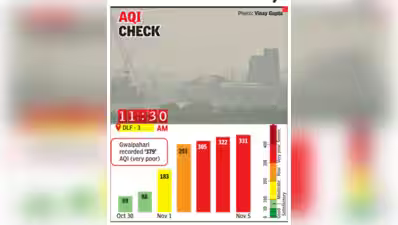
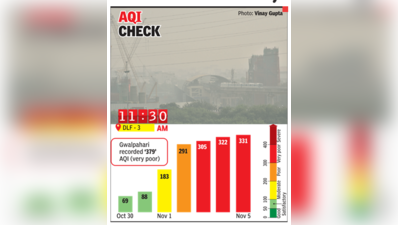
Gurgaon: Air pollution levels are inching towards the severe category at some locations in the city. On Thursday, Gwalpahari recorded an air quality index (AQI) of 379 — ‘very poor’ — even as the overall AQI rose to 331, according to Central Pollution Control Board (CPCB). The city’s overall AQI remained in the ‘very poor’ category for the third consecutive day. The city-level AQI was recorded at 4.05pm, up from 322 on Wednesday and 305 on Tuesday.Among the city’s four operational monitoring stations, Gwalpahari’s reading stood just 22 points short of the severe category, which begins at 401. Teri Gram recorded an AQI of 344, followed by Sector 51 at 313 and Vikas Sadan at 287. While Gwalpahari, Teri Gram and Sector 51 remained in the ‘very poor’ category, Vikas Sadan recorded ‘poor’ air quality.The pollution levels have health implications even at lower AQI categories. According to guidelines issued by CPCB, AQI levels between 0 and 50 are classified as ‘good’, 51 to 100 as ‘satisfactory’, 101 to 200 as ‘moderate’, 201 to 300 as ‘poor’, 301 to 400 as ‘very poor’ and 401 to 500 as ‘severe’. CPCB guidelines state that ‘moderate’ air quality can cause breathing discomfort to people with asthma and lung or heart disease, while ‘poor’ air quality can lead to breathing discomfort for most people on prolonged exposure.Fine particulate matter (PM2.5) remained the dominant pollutant, signalling a persistent winter build-up driven by local emissions and unfavourable weather conditions. The station-level readings showed that average PM2.5 concentrations were higher than PM10 at all four monitoring locations. Data for the 24 hours showed that Gwalpahari had the highest average PM2.5 concentration among the four stations at 379, followed by Teri Gram, Sector 51 and Vikas Sadan. At Gwalpahari, PM2.5 concentrations ranged from 349 to 454, while PM10 averaged 291, with a minimum of 199 and maximum of 430. Nitrogen dioxide (NO2) averaged 19, ranging from 4 to 56, while carbon monoxide (CO) averaged 75, with a minimum of 44 and maximum of 104.At Teri Gram, PM2.5 averaged 344, ranging from 310 to 394. PM10 averaged 304, with a minimum of 188 and maximum of 410. NO2 averaged 71, ranging from 49 to 102, while ammonia (NH3) averaged 16, with a minimum of 12 and maximum of 23. At Sector 51, PM2.5 averaged 313, with concentrations ranging from 66 to 426. PM10 averaged 265, ranging from 38 to 477. NO2 averaged 41, with a minimum of 23 and maximum of 67, while NH3 averaged 13, ranging from 8 to 21. Vikas Sadan recorded the lowest average PM2.5 concentration among the four stations at 287, with a minimum of 157 and maximum of 326. PM10 averaged 222, ranging from 114 to 349. NO2 averaged 5, with a minimum of 1 and maximum of 11, while sulphur dioxide (SO2) averaged 15, ranging from 6 to 26.With calm winds, a low mixing height and winter inversion trapping pollutants close to the surface, significant improvement in air quality was unlikely unless weather conditions changed, such as with stronger winds or rainfall, officials said. Residents have been advised to limit outdoor exposure, avoid strenuous physical activity and use protective masks as the city continues to battle a prolonged spell of poor winter air.Senior consultant (chest physician and bronchoscopist) at Kailash Hospital (Noida) Dr Sudhir Kumar Gupta said fine particulate matter (PM2.5) was the most dangerous component of air pollution because of its ability to penetrate deep into the lungs and enter the bloodstream. “Larger dust particles like PM10 get caught in our nose and throat, but these tiny particles bypass our body’s natural defences completely. They get deep into our lungs and right into our bloodstream. PM2.5 could trigger inflammation across the body, damage blood vessels and increase the risk of heart attacks and strokes. Prolonged exposure could also affect brain health and unborn babies. Toxic air pollution is not simply an environmental issue, but a serious public health issue that can damage nearly all of our major organs in the human body,” Gupta added.All four monitoring stations were operational on Thursday, according to data. Its health advisory warned that very poor air quality could cause respiratory illness on prolonged exposure.RMC zones: To curb air pollution and protect roads from damage by heavy vehicles, dedicated zones for ready-mix concrete (RMC) plants will be developed outside municipal limits. The process of identifying suitable govt land has begun. The plan was discussed in detail on Thursday at the 14th district-level coordination committee meeting, chaired by Haryana’s principal adviser for urban development, DS Dhesi, at the Mini Secretariat.GMDA CEO PC Meena said that a committee headed by the additional deputy commissioner has been set up to identify suitable locations. Officials were told to prioritise govt land outside municipal limits. Besides HSIIDC land, panchayat land will also be explored. During the meeting, the development of more than one RMC zone at different locations was also discussed, if needed, so that all plants can be set up and run in an orderly way within these zones. Dhesi said the idea of developing RMC zones at separate locations outside the city had also come up at a meeting chaired by chief minister Nayab Singh Saini earlier this month. He directed the committee to complete the process in a time-bound manner and submit its recommendations on possible sites without delay. This was aimed at reducing heavy-vehicle movement inside the city, lessening damage to roads and helping control dust and air pollution from RMC plants.