







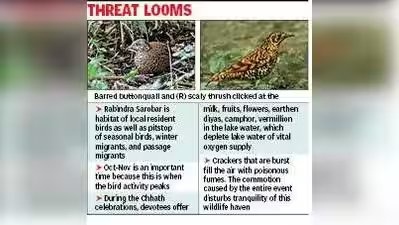
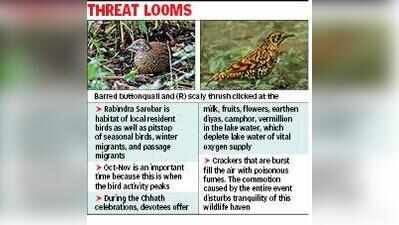
Kolkata: The sighting of a scaly thrush and barred buttonquail at Rabindra Sarobar on Wednesday morning sparked excitement among birders. Birders Sreejeta Sengupta and Priyam Chattopadhyay photographed the birds. With winter approaching, the sighting raised hopes that several migratory birds would arrive at the lake this season.Hours later, the mood among birders turned to concern after minister Agnimitra Paul reportedly indicated govt’s keenness to allow Chhath Puja at Rabindra Sarobar.Adhirup Ghosh, one of the country’s most acclaimed birders who has recorded more than 1,000 species in India, strongly objected to any proposal to allow Chhath Puja celebrations at Rabindra Sarobar Lake.“This is a protected ecological space and an important habitat for avian fauna, fish and other wildlife. Such activities can seriously pollute the water, disturb birdlife and damage the fragile ecosystem. We have witnessed deaths of birds and fish in previous instances and we cannot allow history to repeat itself. As a concerned citizen, I strongly object to this move and demand that Sarobar be protected from all activities that threaten its natural environment,” he said.Techie Sudip Ghosh, who lives on Southern Avenue and was among the first to take up birding at Sarobar after curbs on photography at the lake were lifted in 2011, said allowing Chhath Puja would be “like serving a death penalty” to the environment in and around the lake.“Politicians need to understand why the NGT ruling on this national lake was given in the first place. This is the time when bird activity is at its peak and migratory birds come to Rabindra Sarobar. The scaly thrush was sighted on Wednesday after a long time. If Chhath is allowed now, we are afraid we will lose the birds for good as the habitat will not be the same,” Ghosh said.The day after Chhath Puja in 2018, a dead Indian pond heron was found on the pathway. An ornithologist said the bird had probably died of a heart attack after a cracker was burst nearby. Noisy crackers and loud music from boom boxes had also driven away both resident and migratory birds. While resident birds returned after a few days, the migratory birds left for the season.Sandeep Biswas, an authority on birds and bird identification, said the commotion caused by such events disturbs the tranquillity of the wildlife haven. “Historically, we have seen reduced bird activity and early dispersal of passage migrants after such celebrations. This autumn has been promising so far. We have seen the arrival of various migratory species. Opening up the lakes for Chhath Puja will surely affect our feathered friends and can cause relocation, injury or even death,” he said.Birder Tirthankar Roychoudhury said the ban on such activities had led to a dramatic ecological revival at Rabindra Sarobar. The islands inside the lake had become safe sanctuaries for rare species, he said. The number of painted stork nests has grown from just five to seven earlier to around 20 annually. “We must save this oasis,” Roychoudhury said.