







Ask anyone in India which god is worshipped on Monday and most would answer without a second thought. Shiva. Temples have longer lines. Women keep the Somvar vrat. Lakhs of devotees carry water to Shiva lingas on Shravan Mondays. But fewer people stop to ask why, of all days, Monday is Shiva’s day. The answer lies in the name of the day itself and in a story about the Moon that has been told for thousands of years.
The Name Is the Clue
In Hindi and Sanskrit, it is called Somvar. One of the earliest names for the Moon is Soma. English has the same idea. Monday comes from Moon day.So Monday is the Moon’s day to start with. It is connected to Shiva by the Moon. To see that connection, look at the head of Shiva.
Shiva Wearing the Moon
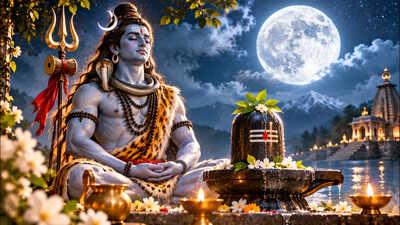
In nearly all images Shiva is shown with a thin crescent moon in his matted hair. One of his names, Chandrashekhar, translates as “the one who wears the Moon as a crown”. Another is Somnath, “lord of the Moon.”The story begins with Chandra, the Moon god, and his twenty-seven wives. They were the daughters of Daksha Prajapati, the 27 Nakshatras. Chandra was meant to treat them all equally, to spend time with each of them in turn. But he loved Rohini the best of all, and favoured her the most.The other wives complained to their father. In his rage Daksha cursed Chandra to wither. The Moon was shrinking, losing his light night by night.In despair, Chandra went to the western coast of Gujarat to the place now known as Prabhas Patan and prayed to Shiva with great devotion. Shiva was touched. He could not entirely reverse Daksha’s curse but he could lessen it. The Moon would shrink for half a month and then grow for the other half. Then Shiva gave Chandra a permanent abode by fixing the crescent on his own head.The temple built there is Somnath, which is the first of the twelve jyotirlingas. It is named after the Moon who was saved there.Therefore, the waxing and waning of the Moon every month is associated with Shiva’s mercy in the Hindu faith. And that is how the Moon’s day became Shiva’s day.
The Deeper Meaning: Silence and the Mind
There is a spiritual side as well. In Vedic thought, the mind is represented by the Moon. It is ever altering, bright today, dark tomorrow, like human moods.Shiva is stillness, the meditating yogi on Mount Kailash. In Shiva’s head-dress, the Moon represents a restless mind held calmly in higher awareness. The Moon is not removed; it is simply held steady.Monday’s prayers to Shiva are considered a practice of calming the mind. Hence, people who are anxious, moody or emotionally drained benefit from worshipping Lord Shiva on Mondays.
How Mondays Are Celebrated
Many devotees fast on a Somvar, eating once a day or only fruit and milk. Inspired by the long penance of Parvati to Shiva, it is traditionally kept by unmarried women hoping to get a suitable life partner. One of the most popular of them is the Solah Somvar vrat, kept for sixteen consecutive Mondays.Abhishek is the main ritual. Water, milk, or a mixture of the two is poured slowly over the Shiva linga, often with bel leaves, white flowers and a little honey. White items suit the Moon’s colour.The common chant is “Om Namah Shivaya” or the Mahamrityunjaya mantra. Some also chant the Chandra mantra “Om Som Somaya Namah” to strengthen a weak Moon in the birth chart.Shravan and Kartik Mondays are thought to be especially powerful. One such Kartik Monday is Monday, November 2. And that day the Moon transits its own sign of Cancer, making Shiva worship especially appropriate.When an Amavasya falls on a Monday, it is called Somvati Amavasya. It is rare and considered a very auspicious day for taking a holy dip and offering prayers.