







NEW DELHI: The Delhi high court’s decision to stay Jawaharlal Nehru University’s (JNU) termination of Congress MP and professor Angomcha Bimol Akoijam has brought fresh focus to a sexual harassment case involving complaints by 11 female students, an internal inquiry that recommended major disciplinary action, a police FIR and allegations of procedural violations by the university.Akoijam, who represents the Inner Manipur Lok Sabha constituency, was dismissed from JNU on October 9 after its Internal Committee examined the complaints and recommended a major penalty.He has denied the allegations and described his dismissal as a “witch hunt”, questioning the inquiry process and accusing the university of violating confidentiality and other prescribed procedures.On Monday, the Delhi High Court stayed the university’s termination order on Akoijam’s petition challenging his dismissal. Justice Anup J Bhambhani issued notice to JNU and listed the matter for hearing in January.The interim order stays the termination decision; it does not amount to a finding on the sexual harassment allegations.
What are the allegations against JNU professor Bimol Akoijam?
At least 11 female students submitted sexual harassment complaints against Akoijam to JNU’s Internal Complaints Committee on May 18.The allegations reportedly included sexually suggestive remarks during viva examinations and classes, inappropriate advances at gatherings at his on-campus residence, and offers of higher marks in exchange for sexual favours.The matter reportedly came to light after a student shared her account of an alleged interaction during a viva examination in a WhatsApp group meant for students.Other students subsequently came forward with similar allegations.The complaints were submitted to the committee on May 18, and the inquiry was expected to be completed within 90 days under the applicable rules. However, the summer vacation between May 27 and July 3 delayed the proceedings.
What did the university decide?
JNU dismissed Akoijam from the Centre for the Study of Social Systems under its School of Social Sciences with immediate effect on October 9.The order, signed by Vice-Chancellor Santishree D Pandit, said the decision followed the Internal Committee’s findings and recommendation of a major penalty under the Central Civil Services (Classification, Control and Appeal) Rules, 1965.The order stated: “Upon following the due process and considering all available facts and as per the report of the Internal Committee (IC), the punishment of dismissal from the services of the University is hereby imposed on the professor.”The committee submitted its report to the vice-chancellor on October 9. However, official sources told TOI that there was a disagreement within the panel over the punishment to be recommended.While the presiding officer and other members favoured a major penalty, student representatives did not sign the recommendation and favoured a lesser punishment.The report was subsequently submitted with dissent after consultations with lawyers, sources said.Under Rule 11 of the 1965 service rules, penalties are classified as minor and major. These range from censure and withholding of promotion or increments to compulsory retirement, removal from service and dismissal.Dismissal ordinarily disqualifies a person from future government employment, unlike removal from service.
Delhi Police register FIR against Akoijam after JNU complaint
The case also led to a police investigation. Delhi Police registered an FIR on October 11 at Vasant Kunj North police station following a complaint by JNU’s chief security officer, who forwarded the university’s dismissal order, the Internal Committee’s inquiry report and its assessment to the police for necessary legal action.The FIR was registered under Sections 75, 75(1)(i), 75(1)(iv) and 79 of the Bharatiya Nyaya Sanhita, which deal with sexual harassment and words, gestures or acts intended to insult a woman’s modesty, among other offences.The Internal Committee’s cumulative assessment referred to what it described as a recurring pattern of inappropriate personal interactions, sexually suggestive conduct and unwelcome physical contact.It also observed that the alleged conduct had created an intimidating, offensive and hostile learning environment for women students, with inadequate professional boundaries in interactions.
Akoijam calls dismissal a ‘witch hunt’, alleges procedural violations
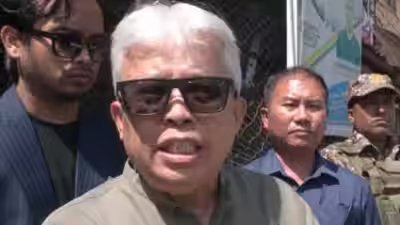
Akoijam rejected the allegations and challenged the manner in which JNU handled the inquiry and communicated its findings.After his dismissal, he said he had not received the Internal Committee’s recommendations or the official dismissal order before learning about the decision through the media.“I have nothing to hide. This is nothing but a witch hunt,” he said at a press conference at his residence in Imphal, adding that he would pursue the matter through legal channels.He accused the university of violating the Sexual Harassment of Women at Workplace (Prevention, Prohibition and Redressal) Act, 2013, particularly Section 16, which bars disclosure of information relating to complaints and inquiry proceedings.He alleged that JNU had disclosed his identity despite the confidentiality requirement.Akoijam also questioned whether he had been given an adequate opportunity to respond to the findings and cited provisions requiring a show-cause notice before action was taken.He said the parties concerned should have an opportunity to appeal against the findings within the stipulated 30-day period.In a post on X, he disputed the university’s claims about his cooperation with the inquiry, the number of communications exchanged and the witnesses he had produced.He said he had submitted a written response to the allegations on May 31 and his deposition on July 16, while also claiming that witnesses had given their depositions on August 14.He described the complaint as politically motivated and alleged that the inquiry process involved procedural lapses and fabrication. Akoijam said his legal team would pursue the matter.
Manipur chief minister seeks Akoijam’s resignation
The controversy also triggered a political response in Manipur. Chief Minister Y Khemchand Singh demanded that Akoijam resign from the Lok Sabha, calling his dismissal “deeply disturbing and shameful”.Singh said the university’s official order indicated that the Internal Committee had examined the allegations and recommended a major penalty before JNU dismissed the professor following due process. He said the allegations against a professor and elected representative had tarnished Manipur’s image.“On moral grounds, Prof Akoijam has lost the moral authority to continue as a public representative and should resign from the Lok Sabha immediately, respecting the sentiment of the people,” Singh said.Former chief minister N Biren Singh also targeted the Congress leadership over the issue. In a social media post, he told Rahul Gandhi: “Kaan Khulke Soonlo. You’ll have to pay for harbouring someone facing serious sexual allegations for political gain.”Biren Singh questioned whether the same standards of accountability that Gandhi demanded from others would apply to his own party. The issue also prompted protests by BJP workers, who sought Gandhi’s resignation as Leader of the Opposition.
Who is Angomcha Bimol Akoijam?
Akoijam is the Congress MP from the Inner Manipur Lok Sabha constituency and was a professor at JNU’s Centre for the Study of Social Systems under the School of Social Sciences. His academic specialisations include social and political psychology and cultural studies.The Delhi High Court’s interim order has stayed JNU’s termination decision, with the matter listed for hearing in January.The sexual harassment allegations remain contested, with Akoijam denying them and challenging the process followed by the university.(With agency inputs)