






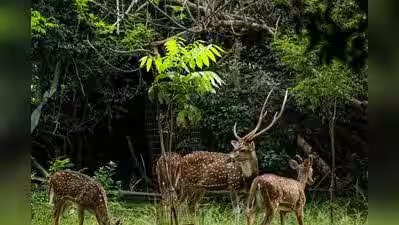
Chennai: Madras Christian College is taking efforts to restore wildlife corridors on its 320-acre campus to prevent spotted deer from venturing into academic areas, including canteens, in search of food. The pilot project will use geoinformatics, native plants and plant-based biofencing. Plants such as fimbristylis, Asian bushbeech, prostrate justicia and Chinese violet will be grown in the core scrub area to provide forage for the deer.The campus, which has one of the largest scrub-jungle patches in the country, is home to more than 100 spotted deer, as well as several other species, including snakes, birds, porcupines, civets and bats. Professors said students often feed the deer, which could affect their health.“Restoring these corridors is aimed at reducing the deer’s dependence on food provided by humans and its encounters with people,” said Paul Wilson, principal of the college and also the president of the Wildlife Conservation Club.As part of the Wildlife Conservation Club’s initiative, the study will use Geographic Information Systems (GIS), including GPS field surveys, satellite imagery and camera traps, to map vegetation patches, identify gaps in the habitat and trace the deer’s movement paths. Spatial analysis will then be used to identify the safest routes linking habitat patches.“Based on these maps, native plants will be planted as a ‘living fence’, or biofence, in three layers: an outer layer along the edge of human-use areas, an intermediate buffer of mixed vegetation and a core corridor planted with native grasses and plants preferred by deer,” said S Saranya, vice-president of the Wildlife Conservation Club.The aim is to guide the deer along safer routes away from academic areas, rather than confine them, she added.The project will be implemented in coordination with the departments of geography and botany.“We have already identified 17 plant species preferred by deer inside the campus. The plantation will reconnect fragmented habitat and provide forage, giving the deer food in natural zones. It will also provide habitat for birds and pollinators,” said M Kumar, a faculty member in the botany department.Following the pilot study, the college is likely to approach its alumni and companies for funds to restore the wildlife corridors.