










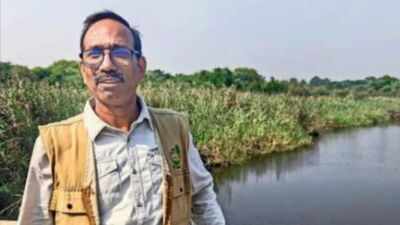
They are perched on faraway trees, hugging a bright and breezy waterbody. It’s a sharp sunny day and one can clearly see the large black birds. Those are Great Cormorants, says bird-watcher expert Faiyaz Khudsar. “And the one sitting alone on the rock is a Snakebird.”We are walking through the Yamuna ecosystem of Yamuna Biodiversity Park (YBP), near north Delhi’s Wazirabad, the site of a 16th century bridge built by Delhi Sultanate ruler Firoz Shah Tughlaq.Wazirabad is boisterous, bustling and unkempt. YBP is its opposite. At the park, we step from the wide, twiggy brush under our feet, and watch a Blue Pansy butterfly float by. You will also come across pathways flanked by tall wild grass and trees with elephant apples — and gasp at the enormous size of bee-hives.Aiming the park’s essential air and animals, the picture-postcard green landscape is hard to believe that two and a half decades ago, the entire area was degraded land, highly alkaline, extremely saline and low on nutrients, where only salt-loving bushes and weeds grew.But a project, conceptualised in 2002 by noted ecologist C R Babu, then pro-VC of Delhi University, and backed by then Lt Governor Vijai Kapoor, transformed the area into a thriving self-sustaining natural ecosystem.What made the project a rarity was the astute administration collaboration between Delhi and Uttar Pradesh governments, and Delhi and Haryana governments, and the Environment and Forests Department of the Government of India.Today, the park is home to a rich diversity of flora and fauna.Around 467 acres in Yamuna’s upstream, YBP is mosaic of wetlands, grasslands and more. “Wetlands are to rivers what kidneys are to the body. They flush out the toxins, clean the water,” Khudsar points out. The green is an enormous reservoir of plant species and a conservatory of butterflies that transports you to childhood.Numbers reveal the project’s exemplary revival and formal diversity. The park features close to 1,017 plant species, 381 bird species, 12 kinds of butterflies, 18 types of reptiles and 22 groups of mammalian families. The park has more than 1,000 visitors every weekend, including school children.[Second column – partially legible]Poach? While talking about the park, Khudsar says it stands as a testament to the importance of biodiversity conservation.Under the meticulous guidance of Babu, YBP grew out of an arduous process. Khudsar says there is ecological history was examined in detail and efforts made to find the nearest possible equivalent. The entire Yamuna basin, nearly 1,400 km in length, was surveyed.The environmental scientist explains how the salt-eating Lankesh? plants … [some text unclear].[Third column – partially legible]The park has a number of bird species, including the Great Cormorant, and many other migratory and resident birds.Khudsar says that in 2012, YBP became the first national park in India to be recognised as a biodiversity park.He also explains how the park is ecologically evolving, with new species being recorded.The park is a good idea for winter visits, especially for birdwatchers and nature lovers.