








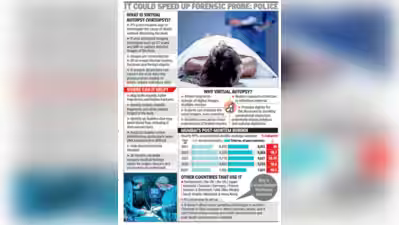
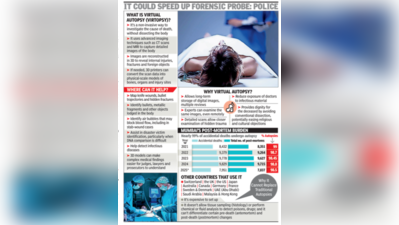
Mumbai: A bullet’s path through a body, the depth of a stab wound or a hidden fracture — all could soon be examined without a single incision.Mumbai is a step closer to making this possible, with a high-tech virtual autopsy centre coming up at civic-run KEM Hospital in Parel. It will allow forensic experts to examine bodies through scans and 3D images instead of conventional dissection.On Friday (Oct 30), BMC floated a tender for a Rs 17-crore, ground-plus-five-storey modern mortuary complex, with a focus on non-invasive autopsies. The centre will use advanced imaging technology to help experts examine internal injuries and establish the cause and mechanism of death in violent or suspicious cases.This will be Maharashtra’s first such centre, with a similar facility also planned at state-run JJ Hospital in Byculla. AIIMS-Delhi introduced virtopsy — as virtual autopsy is also known — in March 2021. According to research papers by the AIIMS team, its CT scanner can capture 25,000 images of the body in seconds, with the entire process taking around 10 minutes, compared with four to six hours for a conventional post-mortem.The proposed Advanced Forensic Medicine and Non-Invasive Autopsy Centre at KEM will also use a CT scanner, while some countries have begun using MRI scanners for virtual autopsies. The KEM project will be executed on a turnkey basis, with a pre-tender meeting scheduled for Nov 5 and Nov 19 as the deadline for bids.“Once the tender is decided, the project should be ready within 11 months,” said KEM Hospital dean Dr Harish Pathak, a leading forensic expert in the country who is in charge of the project.The centre will also have a 3D scanner and a facility to print physical models of body parts, including skulls and bones, showing fractures and other trauma. These models could help investigators understand the trajectory of a bullet or the path and depth of a stab wound.HOW THE PROJECT TOOK SHAPEThe proposal dates back to Nov 2025, when Mumbai police commissioner Deven Bharti approached chief minister Devendra Fadnavis with a plan to introduce non-invasive autopsies as a pilot project at either JJ Hospital or KEM Hospital.A committee led by senior IAS officer Shrikar Pradeshi, with Shailesh Balkawade, additional commissioner of police, and representatives from the medical education department and the two hospitals, examined the proposal and recommended its implementation. BMC commissioner Ashwini Bhide was subsequently asked to oversee the project.“Non-invasive brain imaging systems have already been implemented in countries such as the UK and Japan. Introducing this system in India will increase the accuracy of forensic medical examination and help make our judicial process compatible with systems around the world,” said a committee member, speaking on the condition of anonymity.While conventional post-mortems are still considered the gold standard and may be required in complex cases, virtual autopsies are expected to be quicker. Forensic departments at Mumbai’s teaching hospitals conduct around 10 post-mortems a day. With such a heavy workload, families sometimes have to wait more than 12 hours to receive the body.The scale of the workload is reflected in Mumbai police records, which show that around 98.5% of accidental death cases underwent autopsy over the past five years. Police officers believe imaging-based examinations could help speed up forensic investigations and reduce backlogs.“They can help quickly determine the cause of death and allow for the speedy completion of forensic investigations,” said a senior police officer.A CLEARER PICTURE FOR INVESTIGATORSAn IPS officer familiar with the project said virtual autopsy could help the police not just with investigations but also in handling situations where families object to conventional post-mortems on religious or cultural grounds. “One big advantage of virtual autopsy is that the body is not dissected. It can help preserve the dignity of the deceased and respect the family’s beliefs,” the officer said.For investigators, 3D imaging could offer a more detailed picture of how an injury was inflicted. It could map the depth and path of a knife wound or trace a bullet’s trajectory through the body. It may also help detect minor fractures and internal injuries that could go unnoticed during conventional examinations, particularly in busy govt hospitals handling several post-mortems a day.Digital images could also be shared with specialists across the country and abroad to seek independent opinions. “You need not depend on just one doctor. With 3D images, you can seek multiple opinions,” the officer said.The digital record could prove useful in court, too. Police currently rely on medico-legal certificates and post-mortem reports containing doctors’ expert opinions. 3D images could give judges a visual record of injuries that they can revisit during a trial.“If the defence disputes whether an injury existed, we can always rely on the 3D image, which will be part of the case papers,” the officer said. However, it is too early to say whether the technology will translate into more convictions.The officer said police personnel would need to be trained to understand the reports and explain the procedure to families. Guidelines would also have to be framed on how long digital autopsy records should be preserved.