






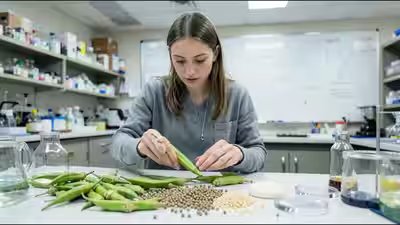
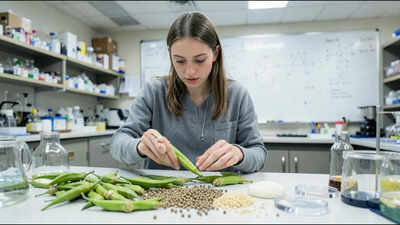
A seventh-grade student from Minnesota has tested whether gels made from common plants could absorb microplastics in a laboratory model of the stomach. Isabella Garry, from Eden Prairie, was named one of 30 finalists in the 2026 Thermo Fisher Scientific Junior Innovators Challenge, according to Society for Science. Her project examined mucilages, plant compounds that form gels, from okra, fenugreek and psyllium. She tested them in an acidic liquid designed to simulate stomach fluid. In the experiment, all three reduced the amount of microplastic remaining in the liquid within 60 minutes. Psyllium recorded a removal result of up to 93.3% at the highest concentration. Okra removed up to 81%, while fenugreek removed up to 82.7%. The final summary does not specify whether these percentages represent averages across trials or the best individual results. It also provides no error bars or results for the control jar. The tests were conducted in jars, so they do not establish whether the gels would work or be safe inside a human body.
How did Isabella Garry test okra, fenugreek and psyllium mucilage against microplastics?
Garry’s project grew out of concern about the presence of microplastics in everyday life. In her finalist profile, she said she first learned about the issue four years ago and initially thought people could simply avoid plastic. She also said she learned that babies were being born with microplastics already in their bodies. This led her to conclude that prevention alone could not solve the problem and to investigate whether natural plant mucilages might offer a way to remove microplastics from inside the human body. Her project, titled A Novel Method for Microplastic Removal From Simulated Gastric Fluid Using Plant Mucilage Flocculants, focused on mucilages from okra, fenugreek and psyllium. These plant compounds form gels in water, and Garry thought they might be able to absorb microplastics.She began by creating an acidic environment to resemble the stomach. Using water, vinegar and salt, she prepared a liquid with a pH between 1.8 and 2.2. She made the microplastic particles by sanding down plastic utensils. She then added the plant mucilages at concentrations of 1% and 2% to Mason jars containing the acidic liquid and 0.5 grams of microplastics. One control jar contained water and plastic particles without any mucilage. To simulate movement during digestion, Garry swirled the jars every 15 minutes. She tested each mucilage six times and weighed the microplastics remaining in the jars after the experiment. This allowed her to compare how much of the prepared plastic material each plant gel absorbed under the same conditions. The setup offered a controlled comparison of three plant-derived materials, but it was not a test of digestion in a living body. The project measured what happened in a prepared liquid during the experiment.
What did the results show about psyllium, fenugreek and okra mucilage?
According to the Society for Science finalist summary, all three mucilages removed microplastics from the simulated fluid within 60 minutes. Psyllium recorded a result of up to 93.3% at the highest concentration. Fenugreek removed up to 82.7%, while okra removed up to 81%. The summary does not clarify whether the reported percentages are averages across the six trials or the best individual results. It also does not include error bars or the control jar’s result, which limits how fully the figures can be assessed. The reported percentages therefore describe the outcomes presented in the finalist profile, rather than a complete statistical comparison of the materials.The findings are an early laboratory result, not evidence of a treatment for microplastic exposure. Garry used particles made by sanding plastic utensils and a prepared acidic liquid, rather than real food, actual stomach contents or living subjects. The experiment does not establish whether the gels would capture microplastics during digestion, pass safely through the body or reduce a person’s exposure. Further research would need to test different plastic types and particle sizes under more realistic digestive conditions, as well as examine the safety of consuming the materials for this purpose.The project also sits within a wider field of research into natural materials that may help remove microplastics from the environment. Another 2026 finalist, Nathan Gael Montelongo, investigated chitosan derived from shellfish for its ability to remove microplastics. He went on to win second place in the Engineering category for his project, “Shellfish Contributions to Ecosystem and Human Health: Evaluating Chitosan’s Natural Ability To Remove Microplastics,” according to the competition’s awards announcement.
What is the Thermo Fisher Scientific Junior Innovators Challenge, and what did Isabella Garry earn as a finalist?
The Thermo Fisher Scientific Junior Innovators Challenge is a US science, technology, engineering and mathematics competition for middle school students organised by Society for Science. The organisation describes it as the nation’s leading middle school STEM competition. The 2026 finalists were selected from nearly 2,000 applicants representing 47 states and five territories, according to the competition’s results announcement. The 30 finalists travelled to Washington, DC, for Finals Week from October 23 to 28. They presented their research and took part in team challenges, with judges assessing their projects and collaborative work. The finalists collectively received more than $100,000 in awards, and each finalist’s school received a $1,000 grant to support STEM programming.Society for Science announced the winners on October 27. Bailey Quinn Frank, from Fort Lauderdale, Florida, received the $25,000 Thermo Fisher Scientific ASCEND Award, the competition’s top prize. Her award recognised both the low-cost environmental DNA sampler she designed and her performance in the team challenges. The device uses a small fan and filter paper to collect airborne bacteria, with the aim of helping monitor environments for pathogens. Frank hopes the affordable approach could make it easier for rural communities to monitor potential health threats where traditional disease surveillance may be difficult.Garry was not listed among the top award or STEM category winners, but her place among the final 30 marked national recognition for her research. Outside the project, she is a figure skater and participates in Technovation, an all-girls coding club and competition in which students develop apps to address real-world problems. She has also taken part in the Technovation Global Challenge, which gave her an opportunity to pitch her apps to investors. Garry hopes to become an environmental scientist. She has credited her grandmother with teaching her that nature and plants can provide many answers. Her project brought that outlook together with concern about plastic pollution, using repeated experiments to investigate whether plant-derived materials could absorb microplastics in a simulated stomach environment.