









HYDERABAD: As strokes increasingly affect young adults aged 18–45, a group traditionally considered to be at low risk, the trend is raising concerns. Once largely associated with older people, city-based doctors highlighted that strokes are now being reported among younger individuals, often with life changing consequences. TOI spoke to young stroke survivors who suffered severe episodes, battled their way through recovery and made significant changes to their lifestyles.TOI spoke to young stroke survivors who battled severe episodes, worked through recovery and made significant lifestyle changes.
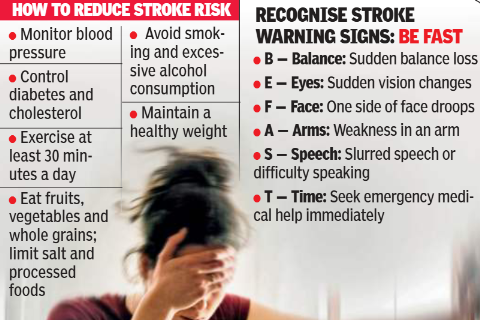
How to reduce stroke risk
Case – 1: 32-year-old recovers after stroke linked to uncontrolled BPA sudden headache, weakness in his right arm and leg, and a drop in consciousness brought P Rajesh (name changed), a 32-year-old tractor driver from Hyderabad, to hospital with a stroke caused by years of undiagnosed and uncontrolled high blood pressure.A CT scan revealed bleeding in his brain, while further tests showed thickening of the heart’s left ventricle, indicating that it had been under prolonged pressure. After treatment to control his blood pressure and reduce pressure inside the brain, Rajesh began improving within five days. He gradually regained strength and underwent intensive rehabilitation.Doctors could not identify a specific underlying cause for his hypertension, but his case highlights a growing concern: strokes are increasingly affecting younger people, including those with no known history of serious illness. Once largely associated with older adults, strokes are now being reported among younger individuals, often with life-changing consequences.“People often think that high blood pressure affects only older adults. But young people can also develop hypertension, and if it is not controlled, it can lead to a serious stroke,” said Dr Hemant K, neurologist at Osmania General Hospital (OGH). Rajesh said he is now able to walk and carry out his daily activities independently.Case-2: 16-yr-old gets new lease of life with surgeryRepeated seizures, sudden falls and declining academic performance left 16-year-old G Jaswant of Siddipet struggling to continue his studies. His family initially believed he was falling because he skipped breakfast. However, tests revealed that he had Moyamoya disease, a rare condition in which the arteries supplying blood to the brain progressively narrow. Within two months, Jaswant had fallen seven to eight times.Dr Yeragunta Thirumal, additional prof of neurosurgery at NIMS, said the narrowing of blood vessels can increase risk of stroke. “He had cerebral bypass surgery on both sides of the brain. The surgeries helped improve blood supply to the brain, and he has since made a remarkable recovery,” he said.Case-3: 18-year-old makes steady recovery after life-threatening brain bleedAn 18-year-old college student, K Pavani (name changed), from Nalgonda suffered a major stroke in Aug. While at college, she developed a severe headache and collapsed. She was taken to a district hospital which referred her to NIMS.Doctors said a CT scan revealed extensive bleeding in her brain. “When she was admitted, she was in a deep coma and could not move her left arm and leg,” Dr Thirumal said. After removing the blood clot, doctors removed part of Pavani’s skull to give the swollen brain more room. She was on a ventilator for three to four days, regained consciousness and was discharged on the 13th day.More than two months after surgery, Pavani said her speech had improved and she could walk with support. “My speech has improved, and I can walk with support. But my movements have not fully recovered. I am continuing physiotherapy,” she said.Doctors stressed that controlling hypertension, diabetes and cholesterol, and avoiding smoking and exercising for at least 30 minutes a day can help reduce stroke risk.“Just a few years ago, we’d be shocked to see a stroke in someone under 40 years. Now young strokes are more frequent than before. Ignoring early symptoms is a big mistake as delayed treatment often means the difference between recovery and lifelong disability,” said Dr B Dinesh Kumar, associate professor in neurology, Gandhi Hospital.