







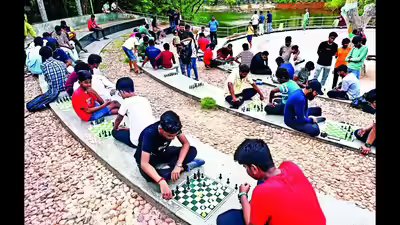
Chess session at the Anna Tower Park
It’s a warm Saturday afternoon, but the pairs – children and adults – bent over chessboards in a corner of Anna Nagar Tower Park are unmindful of the heat. Their aim is not to enter a tournament or even beat the opponent. They are here to just enjoy a good game of chess and, maybe, meet some new people along the way.While there are umpteen academies which promise to up your child’s game to Praggnanandhaa levels, there are few which allow people to play chess for leisure, especially adults. This is what led founders Paul Vannan K and Varun A of the Chennai Chess Club to launch the ‘Chess and the City’ initiative, which invites people to gather at a park once a month to play.
“In New York, there is this concept where people play chess in cafes with strangers, which helps both the café owners and the players,” says Paul. “I wanted to introduce the concept here.” Their ‘Chess Chai Connect’ allows people to meet at a café every Sunday morning and play chess over a hot beverage. Chess boards are provided in both initiatives, and anyone can walk in, whether pros, amateurs or first-timers; all they need to do is to register just so that there is no overcrowding.While Varun was always a chess pro, Paul got interested in the sport during Covid, like many others. “There was a chess boom during Covid, when a lot of people started playing, but there was no means of meeting similar minded people or forming a real-life community, which got me thinking,” he says.The park chess was introduced in Jan, but the interest has so much that the club has decided to conduct the sessions more frequently.“Chess is personal to me since my grandfather taught me how to play, and I wanted to play it in a setting without the pressure to win in tournaments,” says Shwetha R, who attends the park and café sessions regularly. “I started playing chess after a long break because of this opportunity. You also get to chit-chat with people about chess, and it’s a break for many people.”Though people start off playing with random partners in park chess, slowly they are assigned to those who gather the same points as them. “There are small gifts and goodies to those who finish in the top three, but the game per se is nothing technical and the idea is to have fun and meet people. You don’t mind losing,” says Paul.Anwar Basha, 46, is a Zomato delivery man and works from 11am to 10pm every day, but he works only half day on Tuesdays and Wednesdays so he can play chess at the Aaron Chess Academy, Adyar. “It’s a hobby,” says Anwar. “Around the age of 10, I had a friend who taught me the game on the same street where I lived. Later I played with other children on the street, and started enjoying the game.” Anwar attends the chess sessions twice a week at the Academy.Though most of the members are children who aspire to play at a competitive level, there are a few adults such as Anwar who consider it a hobby, says Manuel Aaron, founder and international master. “People of all ages are welcome at our academy. We have a 50-year-old man who comes in once a week, in the evening.”Options to play online chess are available at the click of a button but it’s also an alienating experience, says Paul. “Even if you win, there is no one to share it with. While in face-to-face games, even if you lose, you can discuss the game with the opponents and even get some tips from them on the mistakes you made.”Online chess allows you to play at any time of the day without a partner, says Manuel’s son Aravind, also a player, but there is always the possibility of cheating. “You can always open a laptop and ask for stronger moves on the game you are playing on the computer. People do it all the time, even when there is no prize money involved, even in friendly games.”When a game saved a village from alcoholismMarottichal, a village near Thrissur, is widely known as India’s “Chess Village”, with most of its residents playing the game. In the 1980s, local tea shop owner C Unnikrishnan introduced chess to curb widespread gambling and alcoholism. Over time, the village embraced the game, transforming itself into a largely alcohol-free community centred around intellectual engagement.Grandmaster speakOnline and over-the-board helps hone different skill sets, but the latter can train you for serious tournaments and competitions, says grandmaster Viswanathan Anand. With the rise in popularity of chess in general, the number of casual and hobby players have also increased alongside, he says. “They reinforce each other.” While his academy WACA aims at the strongest youngsters, the pandemic has boosted the popularity of casual chess as well, he says.