










Noida: India is still following air quality standards set 17 years ago because a review to redefine pollution thresholds remains incomplete, a reply from Central Pollution Control Board (CPCB) under Right to Information (RTI) Act has revealed.The reply, dated Oct 26, said National Ambient Air Quality Standards (NAAQS) notified in 2009 continue to apply across the country while a revised report from IIT Kanpur remains under review by a steering committee which was constituted by CPCB on May 6, 2020.The IIT Kanpur-led panel, drawn from All India Institute of Medical Sciences (AIIMS), National Physical Laboratory and IIT Delhi, was entrusted with the task of exploring new parameters, such as ultrafine particulate matter, and widening the 12 criteria pollutants covered by the 2009 guidelines in 2021. It submitted its first report on Oct 6, 2023 and a revised version, incorporating comments from CPCB and the steering committee, on Dec 16, 2025.The steering committee, comprising experts from National Environmental Engineering Research Institute, IITs of Mumbai and Delhi, along with representatives of the environment ministry (MoEFCC), CPCB, India Meteorological Department (IMD) and The Energy and Resources Institute (TERI) and others, has held seven meetings since 2021, with the last on July 1, 2024, to deliberate on the IIT-led panel’s report.The meetings were held “to review the report(s) submitted by IIT Kanpur under the project ‘Review of NAAQS’”, CPCB air quality management divisional head Ankush Tewani said.
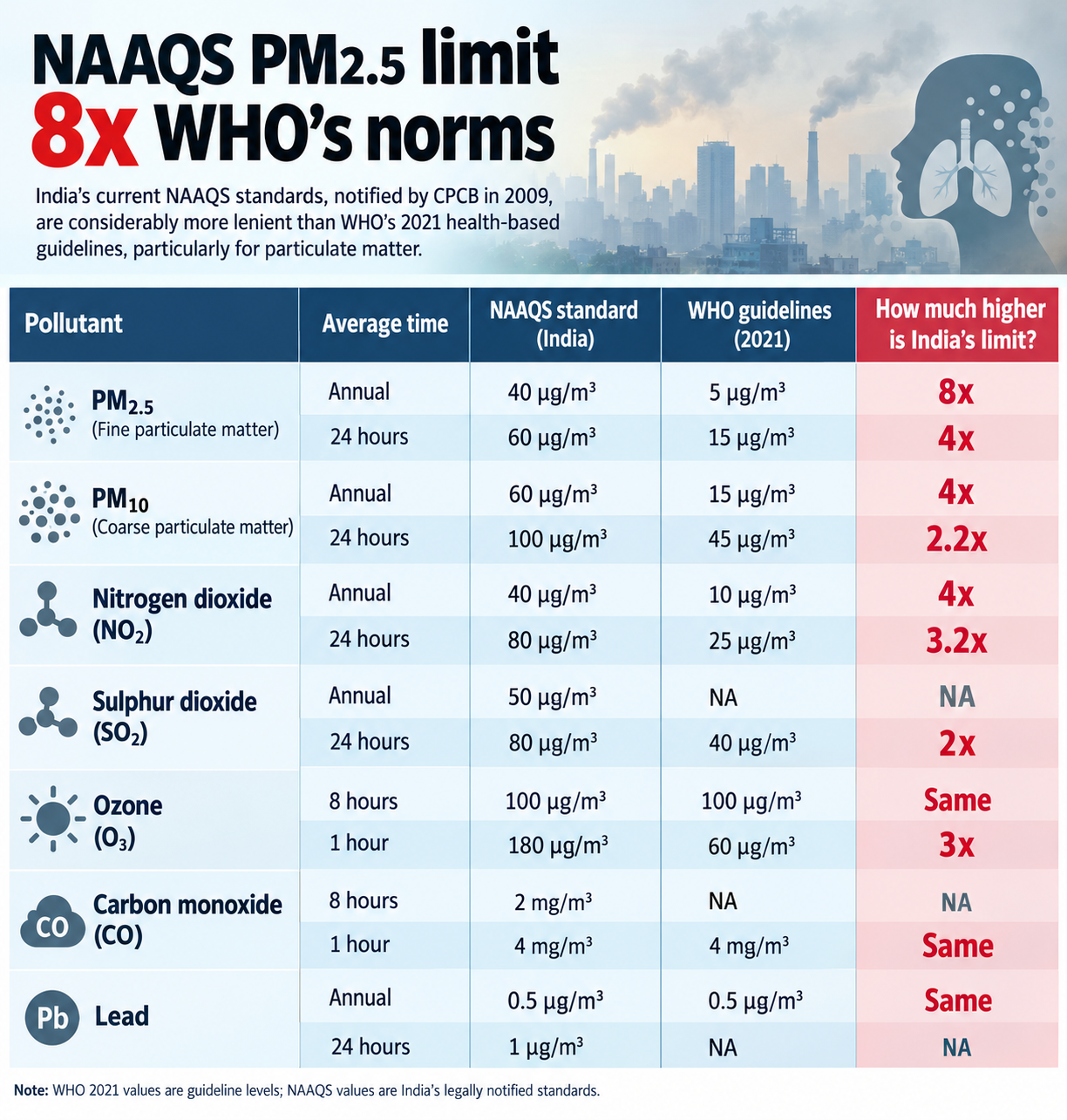
Environmentalist Amit Gupta, who filed the RTI query, said CPCB released Rs 19.6 lakh to IIT Kanpur and tasked it with submitting the final report within three years. The official deadline was Nov 2024, but the institute has submitted only a technical report so far, which, too, continues to remain under scrutiny.While NAAQS standards have not been revised since 2009, World Health Organisaton (WHO) tightened its guidelines in 2021. For example, India’s annual PM2.5 standard continues to remain at 40 micrograms per cubic metre, which is eight times higher than WHO’s safe limit of 5 micrograms per cubic metre. The annual PM10 limit of 60 micrograms per cubic metre is also four times the WHO-recommended 15 micrograms.In a written reply to the Rajya Sabha in Feb 2022, the minister of state for environment had said the review was initiated to improve public health, citing changes in fuel, technology and demographics, and advances in measurement techniques and risk and exposure assessment.Under an MoU signed between CPCB and IIT Kanpur in Dec 2021, the study is expected to deliver a health risk evaluation of pollutants, revised NAAQS, guidelines for determining non-attainment areas and a cost-benefit analysis of implementing the standards. It will review existing limits for carbon monoxide, lead, oxides of nitrogen, ozone, sulphur dioxide, PM10, PM2.5, ammonia, benzene, benzo(a)pyrene, arsenic and nickel.Earlier, Centre for Science and Environment (CSE) executive director (research and advocacy) Anumita Roychowdhury told TOI that it was important to review the standards in light of the new scientific and health evidence as well as the diverse air pollution situation in different regions of India. Some pollutants, Roychowdhury said, may require tighter benchmarks and improved measurement strategies to protect public health.CSE Clean Air Programme manager Shambhavi Shukla said Indian standards for sulphur dioxide, nitrogen dioxide and ozone need immediate revision. “WHO standards are far more stringent, but the older standards are still legally binding in India, so we have to tread the path carefully,” she said. CSE is also a part of the steering committee deliberations.She said the group’s study had found the backlog of pollution to be so high that shutting down all economic activities during the Covid lockdown did not bring concentrations down considerably. “Such experiences say that we have to be stricter in fixing the standards so that legacy accumulation is also addressed over the years,” she added.Gupta, who wrote to CPCB on Tuesday urging it to notify the revised NAAQS soon, said CPCB should consider regional standards given the highly polluted Indo-Gangetic plains instead of a single national benchmark. “Instead of diluting the standards for northern India to fit in the coastal regions or instead of making the standards very strict for regions that have not witnessed growth, there is a need for region-specific standards,” he said.The NCR cities have often topped the list of India’s most polluted. Loni in Ghaziabad was the most polluted city in 2025 with an annual average PM2.5 concentration of 112.4 micrograms per cubic metre, followed by Delhi, Ghaziabad, Noida and Greater Noida. New Delhi was ranked the world’s most polluted capital for the eighth consecutive year in 2026, according to the World Air Quality Report 2025, released by Swiss firm IQAir.