










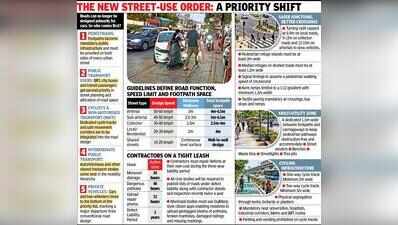
Ahmedabad: Gujarat has inverted the street, straightening priorities to put people first. Pedestrians are in the first tier of the five that categorise road users; private car owners are in the fifth.This future is articulated by urban development department’s latest ‘Guidelines for Road Construction, Street and Junction Design and Signage in Urban Areas’.Footpaths are now compulsory on both sides of every urban street, and engineers can no longer cancel them. Each road must have a continuous, obstruction-free walking zone.The mandatory manual now binds all 169 urban local bodies, including the corporations of Ahmedabad, Surat, Vadodara, and Rajkot, as the state prepares to host the Commonwealth Games in 2030 and readies to bid for the 2036 Olympics.The rules target an infrastructural tendency that affects all cities. When corporations widen a road, the margin pays: footpaths shrink, streetlights move into gutters, and pedestrians become obstacles to cars. A car needs 12-15 square metres to move; a pedestrian needs just 1 square metre.Clear walking widths are 3m on arterial roads, 2.5-3m on sub-arterials, and 2m on local streets. Shared streets will get a continuous level surface. Turning radii are capped at 6-9m on local streets and 12-15m on arterials.“Medians must be at least 1.2m wide and refuge islands 2m. Kerb ramps must not exceed a 1:12 slope and must be at least 1.2m wide, with tactile pavers for the visually impaired,” state the guidelines. “Signals must time pedestrian greens to a walking speed of 1m per second, plus a 3-7 second clearance. Cycle tracks must be 2m wide one-way and 3m two-way, kept clear of parked vehicles and vendors.”A 1.5m multi-utility zone on a road holds vendors’ stalls, benches, bins, tree pits, and streetlights, so the walking path stays clear. Signs must stand 30m apart on local streets and 60m on arterial or main roads, at 2.1-2.5m height, and never in the middle of footpaths, on ramps, on zebra crossings, or on trees, poles, or stalls.No street project will be approved without a working drainage network. Cross-slopes are set at 2.5% for bitumen and 2% for concrete, and cement concrete is mandatory where groundwater lies within 1.5m of the surface or annual rain exceeds 800mm.Verges must become “dust-free” with concrete kerbs and shrubs. New main roads must carry 300mm RCC NP-3 cross-ducts at four-sided junctions, and no road-opening permits will be issued during a contractor’s defect liability period. That period runs for three years, and contractors repair roads at their own cost.Monsoon damage needs base filling within 24 hours, and hazardous defects must be removed within 48 hours. Engineers must upload geotagged before-and-after photographs within 72 hours. Every corporation must run a citizen app, modelled on the roads and buildings department’s GujMarg, where residents can upload geotagged photos of damaged road infrastructure.Each civic body must publish its roads under liability, with contractor names, costs, and inspection scores, on July 1 and Nov 1.