









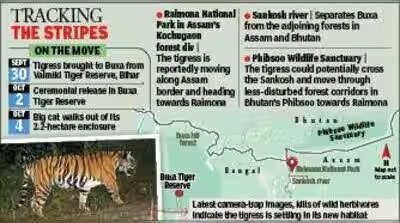
Kolkata: The tigress from Bihar’s Valmiki Tiger Reserve reintroduced into the wild at north Bengal’s Buxa Tiger Reserve (BTR) appears to be pushing deeper into the transboundary forest landscape, with signs of its presence reported towards Assam’s Raimona National Park on the edge of the Sankosh river, around 25-30km from the release site in north Bengal’s Buxa.The three-year-old tigress, BTR-TF1, which was brought by air from Valmiki Tiger Reserve was ceremonially released into the wild on Oct 2. It walked out of its 2.2-hectare enclosure on Oct 4 and has since covered over 350 sq km, exploring the wider forest landscape. Its movement towards Assam marks a significant development in tracking the big cat’s adaptation to its new habitat.Similipal tigress Zeenat had demonstrated how far a big cat could roam across state boundaries when, after leaving the Odisha reserve in Dec 2024, she travelled around 300 km through Jharkhand and Bengal before being tranquillised in a Bankura village and taken back to Odisha.Mustafa Ali Ahmed, divisional forest officer of Kochugaon forest division in Assam, under which Raimona National Park falls, told TOI that his team was recently informed by the Bengal forest dept about movement of the reintroduced tigress towards Assam. “We were informed that it was heading towards Raimona,” he said, adding that Raimona now has around 6 tigers. Raimona shares border with Buxa on its western side.State forest minister Manoj Kumar Oraon told TOI that the tigress was in very good health and was exploring different landscapes within Buxa and its adjoining areas.Experts said such movement was natural for a tiger exploring a new habitat, particularly in a contiguous forest landscape spanning Bengal, Assam and Bhutan. For a big cat, there are no state boundaries in a contiguous forest landscape. Experts said the tigress could potentially cross the Sankosh and move through adjoining forest corridors in Bhutan’s Phibsoo Sanctuary towards Raimona. This corridor, they said, is less-disturbed and is used by tigers for movements between Assam, Bhutan and northern Bengal.“Recent photographs captured through camera traps installed for systematic monitoring indicate that the tigress appears relaxed and comfortable in her surroundings,” Oraon said.Evidence of kills of wild herbivores and scat has also been recorded at different locations traversed by the tigress, indicating feeding activity and continued movement through the landscape, the minister said.The forest dept is tracking the animal through camera traps and radio collar — which has the facilities of both on-the-ground tracking and tracking through satellite signals received at a central location — as it explores different habitat types, vegetations and water bodies. Its movements are part of the initial adaptation phase following its translocation from Valmiki, said a source.The development also highlights the importance of the larger forest corridor linking north Bengal with Assam and Bhutan, where wildlife movement can extend well beyond the boundaries of individual protected areas.