









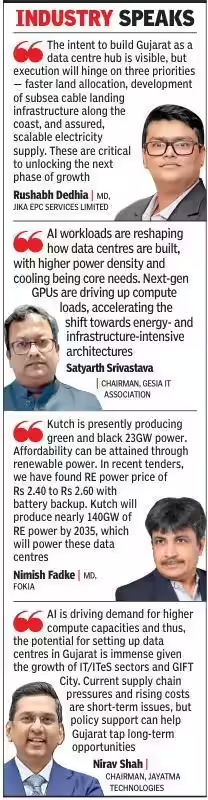
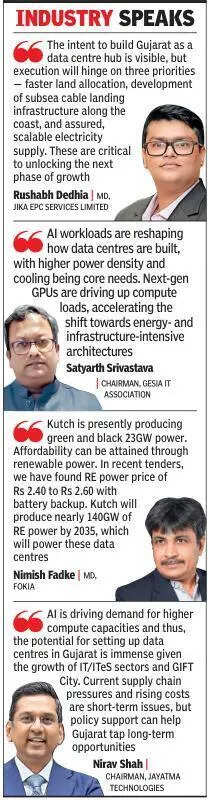
As India’s digital economy scales up, driven by rising cloud adoption, data localization norms and the rapid expansion of online services, the need for robust data centre infrastructure is intensifying. As data consumption rises and artificial intelligence (AI) begins to remap computing needs, demand for a solid digital infrastructure is set to grow sharply. Gujarat, which has so far had a limited presence in this space, is now stepping up efforts to attract investments specifically in the data centre space, with projects by Adani Group and Tata Group marking early momentum.Top sources familiar with the development have confirmed that a dedicated policy for setting up data centres is in the pipeline, and the govt is already carrying out stakeholder consultations to understand industry requirements. For a state known for industrial foresight, Gujarat’s presence in India’s data centre landscape has been relatively limited. It currently hosts just three operational facilities, run by ST Telemedia Global Data Centres, Yotta Infrastructure and CtrlS Datacenters with larger capacity additions still in early stages, despite groundwork by major conglomerates.Therefore, industry players believe that the state’s policy must be very inclusive to be able to position itself as a credible contender in a market dominated by hubs like Mumbai, Chennai and Hyderabad.“Gujarat is well-positioned for large, gigawatt-scale campuses, given its strengths in land availability and power. That said, from an EPC standpoint, Gujarat needs to focus on the supporting infrastructure needed for fast-track data centre build-outs. The govt must also focus on developing locations outside Ahmedabad, such as Dholera, Jamnagar and Mundra, to improve air connectivity and ease of mobilization. This will help the state compete with existing data centre hubs like Hyderabad and Navi Mumbai,” said Rushabh Dedhia, MD, JIKA EPC Services Limited.Policy Catch-Up: A Targeted ModelUntil now, Gujarat has attempted to attract data centre investments through its umbrella IT policy, an approach that industry insiders say lacks the specificity required for a capital-intensive, infrastructure-heavy sector.According to Satyarth Srivastava, chairman of GESIA IT Association, Gujarat is working on a dedicated data centre policy to address gaps in incentives and approvals. Currently, incentives fall under the broader IT policy, but the industry seeks a focused framework covering capital expenditure, faster clearances and long-term viability. This would help Gujarat compete with states like Maharashtra and Tamil Nadu. Srivastava also said a subsea cable landing station in Gujarat would be a “game changer”, improving connectivity, reducing latency and attracting global data centre investments.With a long coastline and proximity to key international data routes, Gujarat is geographically well-positioned, believe industry players. However, the absence of such infrastructure, however, continues to be a critical bottleneck.The Power Factor: Steady Fuel MustBeyond policy and connectivity, the viability of data centres ultimately hinges on three reliable and affordable power.Gujarat enters the conversation with a relative advantage on power availability, supported by its strong industrial base and growing renewable energy capacity. However, AI-led data centres are far more energy-intensive than traditional facilities, requiring high-density, uninterrupted power supply at competitive tariffs.“For developers, viability comes down to two core factors, reliable electricity and access to land. Targeted incentives around these, along with investment in skilled manpower, can significantly improve project economics and accelerate decision-making,” Dedhia said.This becomes even more critical as AI workloads scale up. “Power is not just about availability it is about quality, redundancy and cost predictability over the long term,” said Srivastava.Sources said industry bodies have also recommended a more aggressive incentive framework, particularly around power costs. Suggestions include offering electricity at cost of production, waiving cross-subsidy surcharges and providing long-term tariff certainty to improve project viability.The industry has also sought capital subsidies, interest support and full exemptions on stamp duty and registration to offset the high upfront investments required for data centre projects.Demand Creation: The Missing PieceEven as infrastructure plans gather pace, industry voices point to a deeper issue —demand. “Building data centres is one part of the story. The bigger question is utilization,” said Srivastava, adding, “For Gujarat to truly scale, AI initiatives and digital adoption need to move in parallel.” Unlike Bengaluru or Hyderabad, which benefit from large technology ecosystems and hyperscaler presence, Gujarat’s demand base is still evolving. The state’s strengths in manufacturing, financial services and emerging fintech, particularly within GIFT City, offer a foundation, but may need to be supplemented by stronger digital and AI-led ecosystems.Nirav Shah, chairman of Jayatma Technologies and former president, GESIA IT Association said, “The demand for compute capacity is very high, and AI is the biggest driver behind this surge. The current supply chain pressures and rising costs are a short-term issue, but policy support can help Gujarat capture long-term opportunities.”He added that Gujarat is a strong contender because of its infrastructure advantages. “The quality of power in the state is among the best available, though tariffs remain relatively high. If the state can offer energy at competitive rates, it could attract significant new investments in data centres,” Shah said.The proposed AI data centre in GIFT City could serve as an anchor. “If Gujarat introduces a competitive policy and creates linkages between data centres and AI-focused infrastructure, the state can emerge as a leading hub in this segment,” an industry executive said. The sector believes that promoting AI-oriented data centres in Gujarat would not only boost investment but also accelerate AI adoption across industries.