









Rapid urban expansion, shrinking vegetation and waterbodies, drainage gaps, and low-lying terrain contribute to flood risk, according to a University of Madras study. The city’s flood-risk hotspots include Velachery, Pallavaram, Chromepet and surrounding southern localities, parts of western Chennai, Koyambedu, Villivakkam and areas around Tondiarpet.The study found that between 2000 and 2024, city’s built-up area grew 7.6%, vegetation cover declined 26.14% and water bodies shrank 22.54%. “Spatial analysis show that flood-prone areas are concentrated in low-lying coastal zones, western and southern peri-urban areas, and Adyar River floodplain, where urban expansion, high flow accumulation, and historical flood occurrences overlap,” said first author Rahul Debnath.
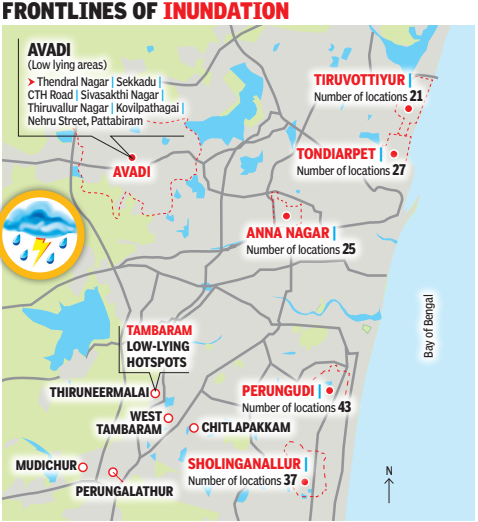
Frontlines of inundation
The study found that roads and buildings replace permeable surfaces, reducing water absorption and increasing surface runoff. Drainage gaps in western and southern peripheral areas overlap with recent urban expansion, suggesting infrastructure has not kept pace with development. Areas more than 1km from mapped stormwater drains were classified as having drainage gaps.The researchers said rain in 2015 exceeded its estimated 100-year return-period intensity, while the 2023 event was associated with a nearly 25-year return period. They recommend integrating land-use planning, terrain characteristics and historical flood records into flood-risk management.Meanwhile, revenue administration and disaster management commissioner B Chandra Mohan said TN identified 1,030 locations with high or very high vulnerability and another 1,003 with moderate vulnerability.“Each location has a plan that is being used for mitigation. It has also got a response plan,” he said. These plans include water-level triggers for action and evacuation, specifying where people should be moved as water rises.While the study identified gaps in drainage coverage, the GCC has expanded its stormwater drain network in recent years. Between 2022 and 2025, 1,144.5km of stormwater drains had been laid, according to the corporation.Greater Chennai Corporation
- 78,161 trees pruned
- 1,670 km of stormwater drains desilted
- 81 km of canals desilted
Tambaram Corporation
- 32 vulnerable locations identified
- 897 km of drains desilted, including
- 344 km of stormwater drains
- 45 km of channels connecting lakes and waterbodies
- 15 shelters kept ready
15 areas flooded up to 5ft last yearThe city corporation will focus on 219 locations identified as flood-prone this northeast monsoon, down from 230 last year due to construction of more drains. OMR has the highest concentration of hotspots, with 43 in Perungudi zone and 37 in Sholinganallur.During the 2023 northeast monsoon, water levels exceeded three feet for several hours at 15 locations. These included Perambur subway, Ganeshpuram subway, MMDA Colony, 100 Feet Road near Arumbakkam metro station, Valluvar Kottam High Road and AGS Colony.This year, GCC and other civic agencies arranged 1,326 motor pumps to drain water. The city has 220 shelters and 111 kitchens ready. “We have deployed more heavy-duty motor pumps. Flood-prone hotspots will be monitored through the Integrated Command and Control Centre,” GCC commissioner G S Sameeran said.To prevent a repeat of the 2015 floods, the water resources department uses the Chennai Real-Time Flood Forecasting System and Real-Time Data Acquisition System to guide water release from reservoirs. The monitoring network is being expanded to include 117 rain gauges, 30 weather stations and 185 water-level recorders across reservoirs, rivers, canals and other waterways.“Water releases are now regulated; they are timed ahead of heavy rain and coordinated with the tides at the river mouths, so that sudden flush releases like in 2015 are avoided,” Sameeran said.Tambaram corporation has identified 32 vulnerable locations, with 15 shelters and nine kitchens ready. Commissioner R Saranya said there was no major flooding last Friday. “East Tambaram underpass was the only place that saw flooding, and it was cleared within a few hours. We have kept heavy-duty pumps in the low-lying areas ready to tackle flooding,” she said.Preparedness (GCC)
- 1,326 Motor pumps ready, across four reported categories
- 311Boats on standby
- 220 Relief camps set up
- 110 Central kitchens ready
Rain report
- Chennai: Annual rainfall –1,382.9mm
- Southwest monsoon (June to Sept) – 434.1mm
- Northeast monsoon- (Oct to Dec) – 867.4mm
- Tamil Nadu: Annual rainfall- 943.7mm
- Northeast monsoon – 447.4mm
- Southwest monsoon- 342mm