








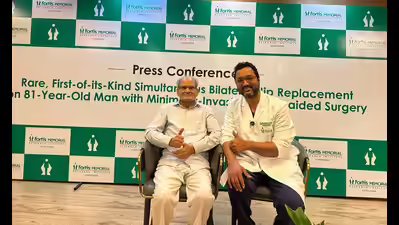
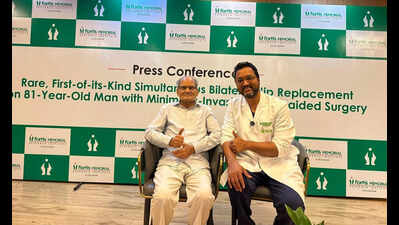
Gurgaon: An 81-year-old retired REC commissioner from west Delhi’s Punjabi Bagh, who was in a wheelchair for four years, has regained mobility after undergoing a rare simultaneous bilateral hip replacement, a high-risk procedure in which both hip joints were replaced in a single surgery.The elderly patient was suffering from advanced avascular necrosis (AVN) in both hips, a degenerative condition caused by reduced blood supply to the bone, leading to progressive joint collapse, chronic pain and near-total loss of movement.Doctors said his advanced age and co-morbidities made the surgery particularly challenging, with risks including blood clots, anaesthesia-related complications and even organ failure.“Any organ could fail. We had to evaluate the patient comprehensively before surgery,” said Dr Debashish Chanda, senior director and unit head of orthopaedics in Fortis Memorial Research Institute, Gurgaon.According to Dr Chanda, detailed pre-operative screening showed the patient’s cardiac fitness was strong enough to withstand the procedure.“Anaesthetic support was very good too and played a crucial role in reducing operative risks. That was a key factor,” he said.Given the patient’s condition, doctors chose a minimally invasive surgery with robotic assistance to replace both hips in one sitting over two to three hours, instead of doing the surgeries separately.Dr Chanda said simultaneous procedures avoided repeated hospitalisation, duplicate surgical preparation and prolonged rehabilitation.Doctors said robotic precision helped reduce tissue damage, improve accuracy and shorten recovery time despite the complexity of the case.The patient stood up on the same day after surgery, began walking the following morning and was discharged within two days.Simultaneous bilateral hip replacement is considered uncommon in octogenarians because of elevated age-related surgical and medical risks, and such procedures are often staged over multiple operations. Doctors said in this case, careful evaluation, a strong cardiac profile, anaesthetic readiness and robotic support were critical in making the surgery possible.