







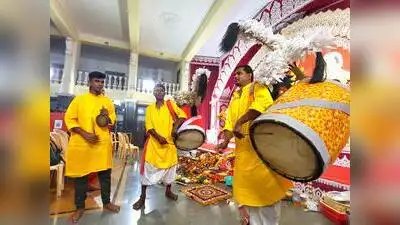
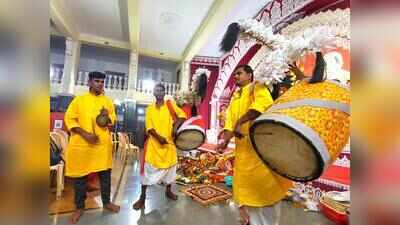
Pics by Shyam of Dhakis at Rohi Villa, Koregaon Park (he will upload this evening)Pune: The booming beat of the dhak does more than announce the arrival of Goddess Durga at Pune’s pandals. It carries the sound of autumn in Bengal, stirring memories of home among those celebrating the festival away from their hometowns. For the dhakis who travel from West Bengal each year, the journey also means earning a livelihood, finding steadier work, and sustaining a tradition that has shaped their lives.For Dilip Santra (37) from Birbhum, his connection with the instrument began in childhood. His uncle, a member of a troupe that travelled across Bengal during Pujo, introduced him to the craft. Santra arrived in Pune with a troupe of eight on the eve of Panchami, marking his third year performing in the city. This year, he played at Kali Bari in Khadki, having performed in Hadapsar and Vimannagar last year.“Things are very different here from what you see in Kolkata. There, the crowd is breathing down your neck. Here, people are more at ease, and they have lived away from home for long. They expect you to give them that feeling of home,” he said.For Santra, this emotional connection gives his performance a purpose beyond the music. “We always tell ourselves that what we do is important. The beats, even if not literally, have some effect on the listener by evoking a feeling of nostalgia,” he said.Pune offers a welcome change from the intensity of competing for attention in Bengal for Subarna Das (32) from Rajdharpur in Murshidabad.A regular performer at Banga Bharati’s Durga Puja in Pimpri for the past couple of years, Das said the atmosphere in Pune was more relaxed than in Kolkata, where dhaki troupes constantly measure themselves against one another.“There is always this feeling of whether I am doing it right or whether I can do it better. Lately, things have become too much to handle, and we do not even get paid as much as we should. Coming here actually helps with those things,” he said.Despite the opportunities, the distance from home weighs on him. “I would really like to stay back with my daughter and wife, but work is important, especially when we get paid enough,” Das said.For Sajjal Kundu (33) from North 24 Parganas, the dhak is one of two crafts that connect him to the festival. His father painted idols and “thakur ghars”, and Kundu has carried on the tradition, painting idols for the past decade. He took up the dhak with friends as a child, gradually turning that youthful interest into a profession.“I have been a painter all my life, and it is almost the same with being a dhaki, but the dhak feels more personal,” he said.Having worked with around six Puja committees in Pune over the years, Kundu said he had gradually developed a greater fondness for the city. “I have gradually come to like the city more than Kolkata,” he said.