








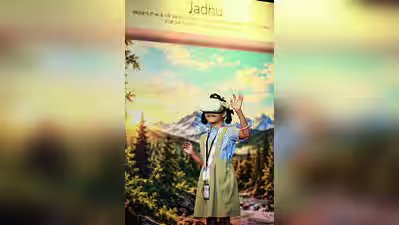
For a child with autism, something as routine as visiting a crowded market, boarding a bus or attending a family gathering can sometimes be overwhelming. But what if the child could practise ‘experiencing’ these situations?Over the past couple of decades, virtual reality (VR) has stepped in to lend a hand, recreating everyday environments, social interactions and life skills.Among the latest to be launched is Jadhu, by non-profit Rewin Health, which helps with brushing teeth, bathing, combing their hair, dressing and eating, which can be a major challenge for those with autism, and which the child may otherwise need to travel to a therapy session for.“Through the VR training, they learn how to do simple tasks. For example, a child may go into the bathroom to brush his teeth and remain there for three hours unless someone knocks on the door and asks them to come out,” says Vijay Karunakaran, founder of the VR tool.Jadhu, he says, also teaches basic cognitive skills, arithmetic, behavioural skills and communication. “Our technology creates real-world scenarios. Like a pilot training in a simulator, we measure anxiety, identify what triggers it in real-time and help them calm down and try again,” he says.Avaz, a picture-based augmentative and alternative communication (AAC) app, is another. “Children are often silent and just nod their heads. This app allows them to express exactly what they want,” says Simy T A, principal, Centre for Special Education, Vidyasagar. “We introduce Avaz to children from the age of six. They learn that it is a device to communicate, and we also use it in the classroom.”Vijay says a Tamil Nadu survey they did found that 11 of 38 districts did not have dedicated services for neurodivergent children within 25km.“Most families were travelling more than 30 minutes for treatment. Our survey found that six of 10 families of those with intellectual disabilities wait more than a year to receive a diagnosis. Virtual reality can come in handy for such families.”At the NGO Swabhimaan Trust, which works with people with autism, trustee Parthibhan K has been using virtual reality for more than a year now.“We’ve been simulating experiences such as railway stations and bus stops to help children build the confidence to venture out,” he says.