









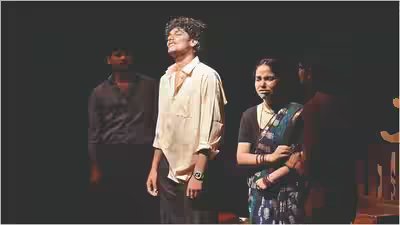
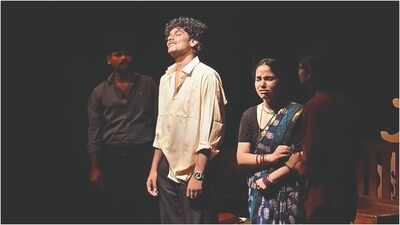
The play begins like a whisper. A corner apart from the main stage is suddenly brought into relief. Yellow lights overhead come to life, and a man named Bhagwan is seen murmuring to himself, and then gently swaying to some music which only he can seem to hear. A cinematic beginning that immediately commands your attention.Cut to another scene, and we see Bhagwan’s wife and friend at his place, discussing his whereabouts. It was Bhagwan’s birthday and he was nowhere to be seen. Later, Bhagwan appears wearing a distant but satisfied expression. His wife and friend berate him.Bhagwan then narrates the story of his village boatman who used to claim that he could speak to birds. He was ostracised soon after. Bhagwan said the villagers labelled the boatman a lunatic, but now, years later, he understands him, as he also finds great joy in nature and in conversing with bees and butterflies.This foreshadowing by actor Kartik Pandey, who essayed Bhagwan, suggests that perhaps he is about to meet a similar fate as the boatman. He has stopped going to work, instead imagining children playing in the deserted park where he sits by himself, “speaking to the birds”. The evocative and haunting monologues of Bhagwan make us wonder – are these the ravings of a mad man, or timeless pearls of wisdom?The lead performance and the direction do much of the heavy lifting, with Manav Kaul’s vulnerable writing letting the viewers have a glimpse of Bhagwan’s state of mind, who thinks he has experienced an ilhaam – a divine revelation of how the world exists. He now experiences everything like a newborn, or an animal – a worldview that doesn’t require external validation, and is alive with a sense of joy and wonder.The protagonist’s conversation about divinity and the universe with popular Hindi comic character Chacha Chaudhary, and his ability to communicate with the mute beggar Mohan without using sign language are presented with the right amount of awe and intrigue. That such heavy concepts could be delivered in merely an hour without resorting to any special effects or jargon was remarkable.In the end, Bhagwan does seem to get what he wants, but pays a heavy price for it. What he ultimately chooses is less important than the fact that he is forced to pick between two versions of happiness – to be joyous and abundant, having attained something akin to enlightenment, or to live a socially acceptable, “normal” life._-Anvita Singh

Want us to review your play? Mail us at tims.delhitimes@timesofindia.com